How to Build a PHI-Safe, AI-Enabled Data Layer
Most healthcare AI projects stall on one question: how do you let a model touch patient data without creating a compliance problem?
Encryption isn't the answer. It protects data at rest and in transit — and says nothing about who reads PHI in use, what your models and logs retain, or which third parties your prompts flow to.
This guide is the architecture that answers it. Vendor-neutral, written by the engineers who build it.
No sales call. Straight to your inbox.
50+ healthcare products shipped·Zero HIPAA violations·ISO 27001 & 27701 certified
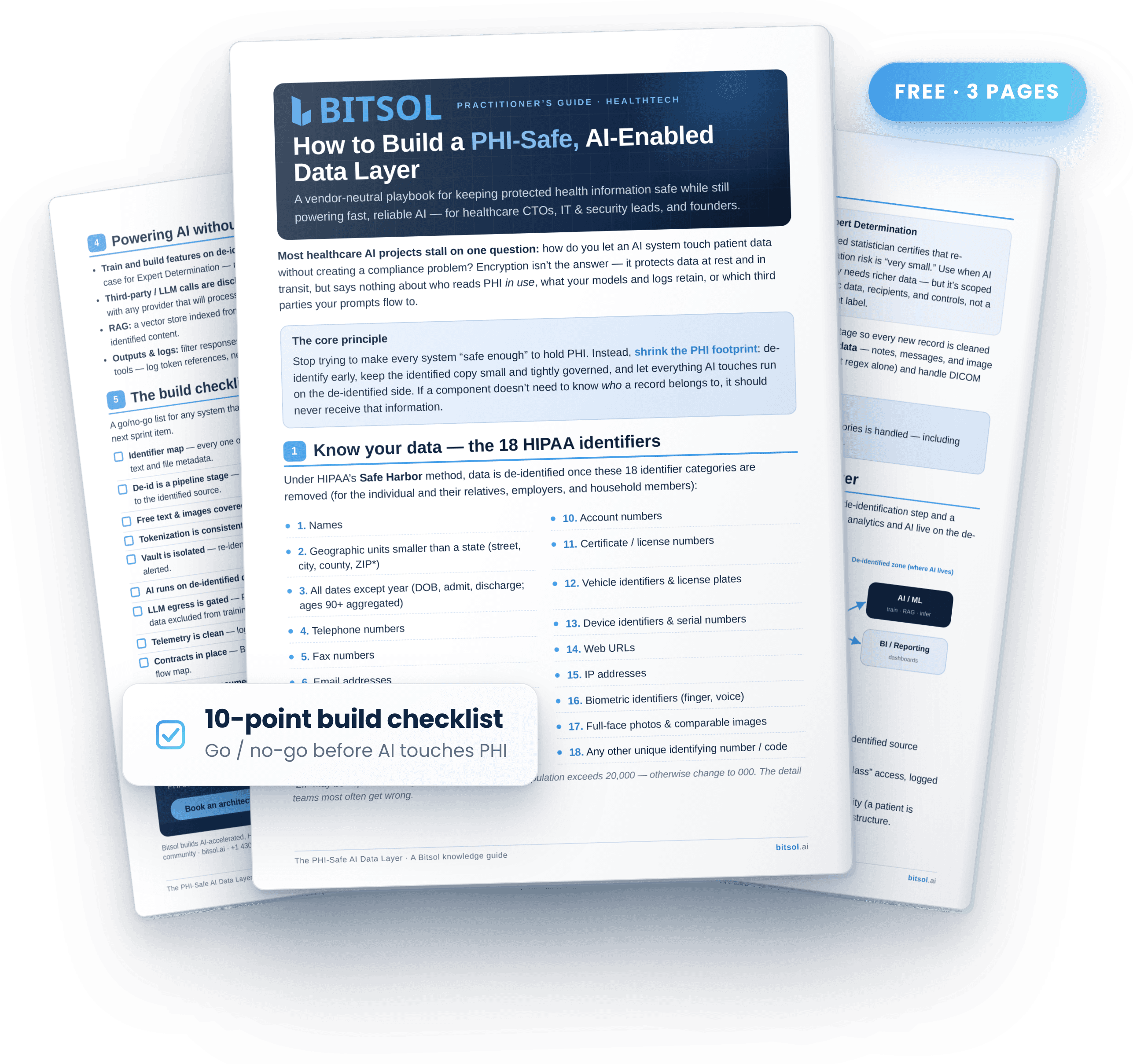
Stop trying to make every system “safe enough” to hold PHI.
Shrink the PHI footprint instead. De-identify early, keep the identified copy small and tightly governed, and let everything AI touches run on the de-identified side.
If a component doesn't need to know who a record belongs to, it should never receive that information.
What's inside
The 18 HIPAA identifiers
All eighteen Safe Harbor categories in one place — including the ZIP-code rule teams most often get wrong, and why it matters for your feature set.
Two paths to de-identification
Safe Harbor versus Expert Determination: when each applies, what each costs you in data richness, and why "de-identified" is a scoped determination rather than a permanent label.
A reference architecture
The identified zone / de-identified zone split, connected by a single enforced de-ID gateway and a tightly held token vault. Diagrammed, not described.
Powering AI without exposing PHI
Why third-party LLM calls are disclosures, why a vector store indexed from clinical notes is a PHI copy, and how to keep PHI out of logs, traces and error tooling.
The 10-point build checklist
A go/no-go list for any system that touches health data and feeds AI. If you can't check a box, that's your next sprint item.
Who it's for
Healthcare CTOs and engineering leads
You need a defensible architecture before a security reviewer asks for one.
IT and security leads
You're being asked to approve AI tooling and need a framework for what can cross the boundary.
HealthTech founders
You're adding AI and don't yet know where PHI ends up.
The problem this solves
"We encrypt everything, so we're fine."
Encryption protects data at rest and in transit. It doesn't govern who reads PHI in use, what your model retains, or what leaves in a prompt.
"We'll de-identify before we ship."
De-identification is a pipeline stage, not a milestone. Do it once and every record created afterwards arrives identified.
"Our AI vendor is SOC 2 certified."
SOC 2 is not a BAA. If a provider can receive PHI, you need an agreement and an exclusion from training — or you need to not send PHI.
"We only send de-identified data to the model."
Can you evidence that, field by field, including free text and file metadata? That's the test the guide gives you.
Get the guide
Three pages. No gate on the useful part — the whole thing is in the PDF.
We'll email the PDF immediately. We may follow up once about how we build these — unsubscribe in a click. We don't sell or share your details.
Building AI into a healthcare product right now?
The guide gives you the architecture. If you'd rather have it built, we ship HIPAA-compliant clinical AI systems in 8 weeks — PHI-safe, auditable, and clinician-in-the-loop.