
Most HealthTech products don't fail because the idea was wrong. They fail because compliance arrived too late to save them. A founder ships a working prototype, signs a first pilot, and then a hospital's security questionnaire lands — forty questions about encryption, access logs, breach procedures, and business associate agreements the product was never architected to answer. Suddenly the roadmap stops, and an eight-week rebuild becomes a six-month one.
This is the quiet tax on Digital Health startups that treat HIPAA compliance as a phase instead of a foundation. The good news: it's avoidable. Building HIPAA-compliant software from day one is not slower or more expensive than building it "normally" — it's only more expensive when you retrofit. This guide walks through why compliance-last is the costliest decision a HealthTech team can make, what's changed in how buyers and regulators evaluate you, how the requirements actually differ between an MVP and an enterprise deployment, the concrete architectural choices that let you move fast and stay compliant, and — the part most teams miss — how to design your system so that you need far fewer business associate agreements in the first place.
Why "Add Compliance Later" Is the Most Expensive Decision in HealthTech
Retrofitting compliance means touching the parts of a system that are hardest to change: your data model, your authentication layer, your logging, and every integration that already moves patient data. Bolting Healthcare Data Security controls onto a product that wasn't designed for them usually means re-architecting, not patching.
The reason is dependency depth. A retrofit is rarely one change — it cascades. Introducing field-level encryption after launch means rewriting every query that filters or sorts on a now-encrypted column. Introducing tenant isolation after launch means backfilling a tenant key through every table, every index, every cached object, and every background job. Introducing audit logging after launch means you can produce a log going forward but cannot reconstruct the past, which is precisely what an incident investigation asks for. Each of these is individually survivable. Arriving together, during a pilot, with a security reviewer waiting, they are what turns a quarter into a year.
The financial stakes are not abstract. Healthcare has ranked as the most expensive industry for data breaches for more than a decade in IBM's annual Cost of a Data Breach report, with an average incident cost approaching $10 million — far above the cross-industry average. And breaches are not rare edge cases: the U.S. Department of Health and Human Services publishes every reported breach affecting 500 or more individuals on its public Office for Civil Rights breach portal, a running record that prospective enterprise customers absolutely check before signing.
Beyond breach costs, HIPAA enforcement carries tiered civil penalties that now exceed $2 million per violation category per year at the top tier — and that's before the reputational damage of appearing on a public breach list while trying to close your next round. For an early-stage company, a single compliance failure during a pilot can end the commercial relationship that the entire runway was built around. The lesson founders learn the hard way is simple: in regulated healthcare, HIPAA Compliance isn't a feature you add. It's a property of how the system is built.
What's Changed: Compliance Has Moved Upstream
A few years ago, a HealthTech startup could reasonably defer serious compliance work until it had traction. That window has closed. Three shifts have pulled compliance to the front of the build.
First, buyers diligence earlier. Health systems and payers now run vendor security reviews before pilots, not after — and increasingly expect evidence of SOC 2 or ISO 27001 controls from companies that are barely out of seed stage. Second, investors have caught on; technical due diligence for Digital Health rounds routinely probes data handling and breach exposure, because a compliance gap is a valuation risk. Third — and most encouraging — the tooling has caught up. Modern Healthcare Cloud Solutions from the major providers now offer HIPAA-eligible services, signed business associate agreements, and managed encryption and logging out of the box. The infrastructure that once made "compliant by design" expensive is now the default path. The founders who win are the ones who treat that infrastructure as a starting point rather than a someday-upgrade.
MVP vs Enterprise: The Myth That Costs Founders a Year
Here is the playbook that used to work and no longer does: skip compliance during the MVP, validate the idea, then "do it properly" in stage two once there's revenue to justify the investment.
The logic is seductive because it sounds like good prioritization. Why build enterprise-grade controls for a product that fifty users might reject? But the playbook confuses two different things — the scope of compliance and the architecture of compliance. Scope absolutely should scale with the company. Architecture should not have to change at all.
What teams discover in stage two is that the items they deferred were not features sitting at the edge of the system. They were foundations: how identity is modelled, how records are partitioned, where keys live, what gets logged, and which third parties see what. Those are the highest-dependency decisions in the codebase. Deferring them doesn't postpone the cost — it multiplies it, because by stage two there is production data to migrate, live customers to avoid disrupting, and an integration surface that has grown in every direction.
What genuinely differs between an MVP and an enterprise deployment
Plenty does differ, and pretending otherwise leads to over-building. The distinction that matters is between structural decisions, which are cheap now and brutal later, and procedural ones, which are genuinely fine to defer.
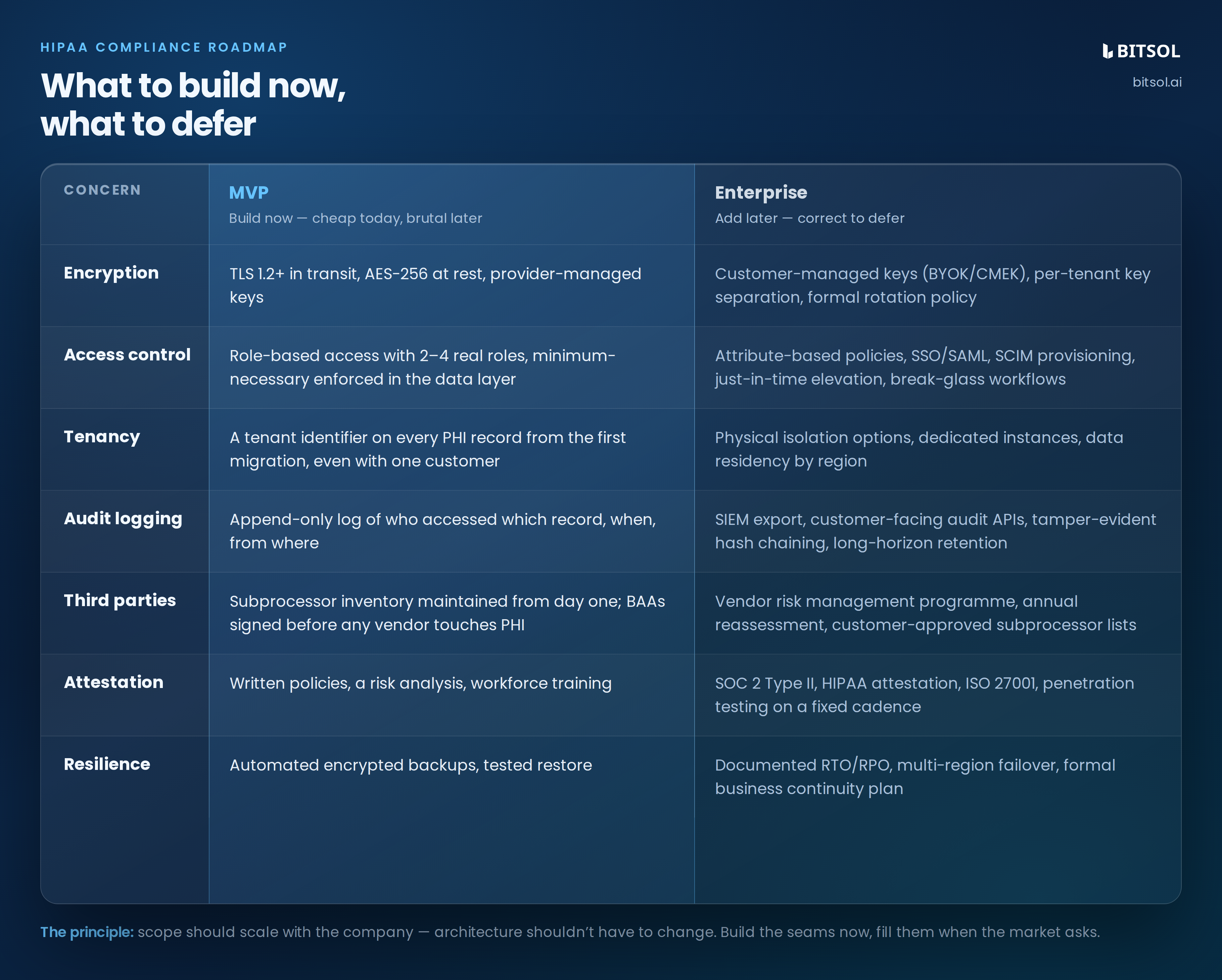
Read the left column carefully: almost none of it is expensive. A tenant column on a table costs nothing on day one and costs a migration weekend in year two. Choosing a managed key service over a hardcoded secret is a first-sprint decision, not a project. Writing an append-only access log is a middleware function.
The right column is where the real cost sits, and it is genuinely correct to defer it. SOC 2 Type II requires an observation window you cannot compress. Customer-managed keys only matter when a customer asks. Multi-region failover is meaningless before you have uptime commitments.
So the honest framing is not "compliance early versus compliance late." It's: build the seams now, fill them when the market asks. An MVP that ships with tenant identifiers, real roles, managed keys, and an access log is not an over-engineered MVP. It is an MVP that can accept an enterprise contract without a rewrite. Our earlier piece on why HealthTech products fail and how early validation can change that makes a related point from the product side: validation and durability are not opposing goals.
Building HIPAA-Compliant Software from Day One: A Practical Blueprint
The HIPAA Security Rule organizes its requirements into three categories of safeguards — administrative, physical, and technical. For a software team, those translate into a handful of concrete engineering decisions you can make in your first sprint.
Encrypt everything, everywhere. Protected health information (PHI) must be encrypted both at rest and in transit. In practice that means TLS 1.2+ on every connection and disk- or field-level encryption on every store, with keys managed through a dedicated key management service rather than checked into your codebase. This is a first-week decision, not a hardening pass.
Worth being precise about the two layers, because teams routinely conflate them. Volume or disk encryption — the default on managed databases — protects against physical media compromise and satisfies the baseline. It does not protect against a compromised application credential, because to the application the data is already decrypted. Field-level encryption protects specific columns (identifiers, clinical notes, free-text fields) so that a leaked database dump or an over-permissioned internal query returns ciphertext. Use envelope encryption so that a data key encrypts the field and a master key in your KMS encrypts the data key, which makes rotation possible without re-encrypting every row. Decide early which fields need field-level treatment, because retrofitting it breaks every query that filters or sorts on those columns.
Control access by role, and prove it. Implement role-based access control and the "minimum necessary" principle from the start — no engineer or service should reach more PHI than its job requires. Pair that with immutable, tamper-evident audit logging that records who accessed which record and when. When a customer's Healthcare IT team asks how you'd reconstruct an incident, that log is the answer.
Two implementation details separate a control that passes review from one that doesn't. First, enforce minimum-necessary in the data access layer rather than the UI. A hidden button is not an access control; a query that cannot return rows outside the caller's scope is. Second, make the audit log append-only in storage, not just by convention — write-once storage or hash-chained entries, so that "immutable" is a property you can demonstrate rather than assert. Log reads, not only writes. Reviewers ask who viewed a record far more often than who edited one.
Sign a BAA with everything that touches data. Every third party in your stack that processes PHI — your cloud host, your email service, your analytics pipeline — needs a Business Associate Agreement. Map your subprocessors early; a single unsigned BAA is an instant violation regardless of how strong the rest of your architecture is.
Minimize and de-identify. Store the least PHI you can, and de-identify data before it flows into environments that don't strictly need it (analytics, model training, staging). The HIPAA Safe Harbor method's 18 identifiers give you a concrete checklist for what to strip.
Data minimisation is the most underrated control on this list because it reduces obligation rather than adding protection. Every field you don't collect is a field that cannot leak, cannot be subpoenaed, and cannot appear in a breach notification. Apply it to retention as well as collection — a defined deletion schedule shrinks the blast radius of any future incident. And treat non-production environments as first-class: seeded synthetic data or Safe Harbor de-identified extracts in staging removes an entire category of exposure that security reviewers specifically probe for.
These are not exotic techniques — they're standard patterns that cost little when designed in and enormous amounts when retrofitted. If you want the week-by-week version of how this fits into a real build timeline, Bitsol's 8-Week HIPAA-Compliant MVP Launch lays out the exact cadence, and our earlier guide on how to develop a HIPAA-compliant application goes deeper on the safeguards themselves.
The Overlooked Move: Designing So You Need Fewer BAAs
Most compliance guidance stops at "sign a BAA with every vendor that touches PHI." That's correct, but it treats the number of BAAs as fixed. It isn't. It's an output of your architecture — and a good architecture produces far fewer of them.
This matters because a BAA is not a one-time signature. It's a permanent operational commitment: annual vendor reassessment, breach notification chains that now include a third party's timeline, subprocessor changes you must track and sometimes disclose to customers, and one more name on the list an enterprise security reviewer will scrutinise. Every avoidable BAA you avoid is recurring overhead you never take on.
The underlying principle is simple. A vendor needs a BAA when it creates, receives, maintains, or transmits PHI on your behalf. If the vendor never receives PHI, the obligation doesn't arise. So the design question becomes: which of these integrations genuinely require patient data, and which merely receive it because that's the default?
Separate the PHI plane from the application plane. The highest-leverage decision is architectural. Keep PHI inside a defined boundary — a specific set of services, databases, and network segments — and require everything outside it to operate on non-identifying references. Most of your stack (feature flags, product analytics, error monitoring, notification orchestration, support tooling) has no clinical reason to see a name or a diagnosis. It needs to know that user 8f3c performed action X. Our guide on how to build a PHI-safe, AI-enabled data layer breaks down exactly how to draw and enforce that boundary.
Tokenise at the boundary. Replace identifiers with opaque surrogate tokens before data crosses outward, and keep the mapping table inside the PHI boundary. The vendor gets a stable key it can join on; it never gets an identity. This preserves almost all analytical utility while removing the vendor from scope.
Make notifications content-free. Transactional email and SMS are where PHI leaks most casually — appointment reminders naming a clinic, subject lines naming a condition, message bodies summarising results. Send "You have a new secure message. Sign in to view it" and put the content behind authentication. The same pattern applies to push notifications, which are rendered by platform services outside your control.
Scrub before you transmit. Error monitoring and session replay are the two tools most likely to exfiltrate PHI without anyone intending it, because both capture whatever is on screen or in a request body. Configure server-side scrubbing before transmission rather than relying on vendor-side filtering, mask PHI-bearing DOM elements by default, and disable replay entirely on clinical screens. A default-deny posture is the only one that survives a new engineer adding a field.
De-identify before analytics and model training. Applying Safe Harbor's 18-identifier removal — or a documented Expert Determination — before data reaches your warehouse or a training pipeline changes its regulatory character. This is also the entry point for using AI tooling without handing a model provider a patient record, which is a question every HealthTech team is now facing. Our guide on how to build a PHI-safe, AI-enabled data layer walks through the architecture in detail — worth a read if you're weighing which AI vendors need to be inside your compliance boundary and which can be designed out of it.
Prove it, don't assert it. This is the caveat that makes the strategy defensible rather than wishful. "We don't send PHI to that vendor" is a claim you will be asked to evidence. Back it with automated egress testing against known PHI patterns, contract tests in CI that fail when a payload to an external endpoint contains a restricted field, and a documented data flow diagram per integration. Without that, you have an assumption, and assumptions are what post-incident reviews dismantle.
Two honest limits. This strategy shrinks your BAA surface; it does not eliminate it. Your cloud provider, anything storing PHI, and any genuine clinical integration still require one — and you should sign those readily. And "de-identified" is a legal determination, not a vibe: partial masking that still permits re-identification through combination is still PHI. Where the boundary is genuinely ambiguous, sign the BAA. The goal is fewer BAAs by design, not fewer BAAs by optimism.
How Bitsol Approaches HIPAA-Compliant Builds
At Bitsol, compliance isn't a checklist we run at the end — it's the architecture we start from. Our 8-Week HIPAA-Compliant MVP Launch is built for founders who need to validate fast without inheriting a compliance debt that stalls them at their first enterprise pilot. From the first sprint, we design the data model, access controls, encryption, and audit trails around HIPAA's safeguards, on HIPAA-eligible cloud infrastructure with the business associate agreements already in place. We also draw the PHI boundary deliberately, so the integrations that don't need patient data never receive it — fewer agreements to maintain, and a smaller surface to defend when a security review lands. The result is a product that can survive a hospital's security review on the day it ships, not six months later. If your team is racing toward a pilot and worried compliance will slow you down, that's exactly the tension we're built to resolve. Explore the 8-Week HIPAA-Compliant MVP Launch →
The Bottom Line for HealthTech Founders
The founders who build durable HealthTech companies aren't the ones who move fastest in month one — they're the ones who never have to stop and rebuild in month nine. Designing for HIPAA Compliance from day one doesn't cost you speed; it protects the speed you already have by keeping compliance off your critical path when a real customer shows up. As buyers and investors push their scrutiny earlier and the compliant infrastructure gets cheaper to adopt, the gap between "compliant by design" and "compliant by scramble" will only widen. Build the foundation once, build it early, and let it carry every product decision that comes after. Your future self — closing an enterprise deal without a six-month detour — will thank you.


