Part 2 of a two-part series. Part 1 covered what a clearing house does and how the X12 transaction set fits together. This part is about building the integration — timing, failure modes, security, and vendor selection.
The easy part is submission; everything after it is the hard part
Most HealthTech teams discover the same thing once their first claims go out: sending the claim was the simple hour of the project. What breaks integrations is everything that happens afterward — acknowledgments that arrive minutes or days later, remittances that show up weeks on, responses that come back out of order, and some that never come at all. A billing flow is not a request-and-response; it is a weeks-long asynchronous conversation, and Healthcare IT systems that were designed as if it were synchronous fail in expensive, silent ways.
In Part 1 we built the map: what each numbered transaction means and when it arrives. This part turns that map into a durable integration. We'll walk the full claim lifecycle and its timing, name the four functions a clearing house actually performs, confront the enrollment timeline that derails schedules, and get concrete about the design decisions — idempotency, soft-failure handling, and Healthcare Data Security — that decide whether the system holds up under real payer behavior. We close with the metrics that prove it worked and the questions that separate clearing house vendors.
1. The claim lifecycle: sequence and timing
The transactions form a sequence spread across a timeline that spans weeks.
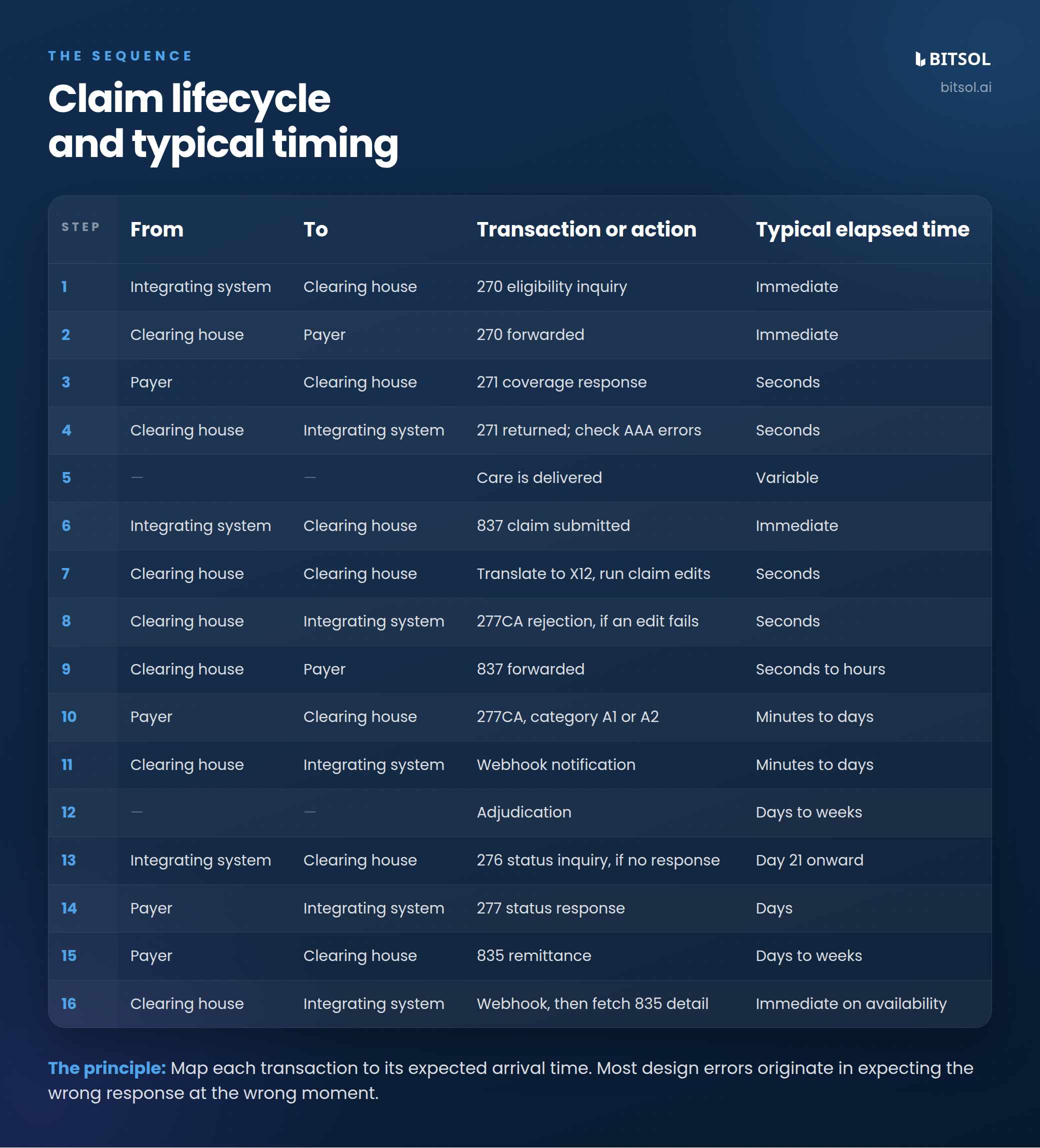
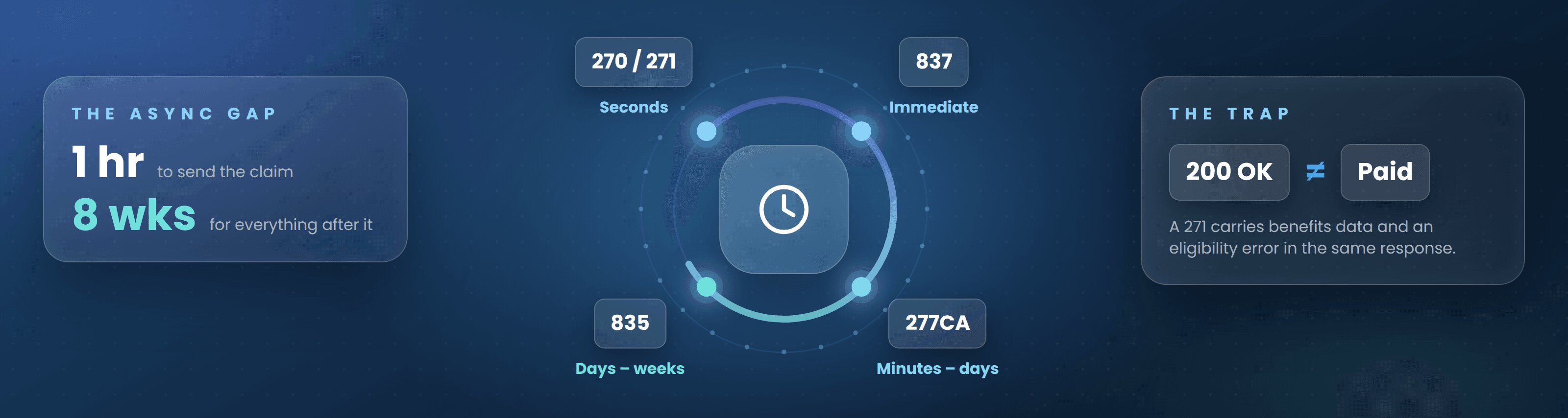
Eligibility is synchronous. Everything following submission is asynchronous, webhook-driven, and may arrive out of order.
This asymmetry is the defining property of the integration. Eligibility is a request and response that can be presented behind a loading indicator. A claim is an exchange unfolding over weeks, in which responses arrive unprompted, occasionally out of order, and sometimes not at all. Designing for this behavior from the start is considerably less costly than retrofitting it.
The same lifecycle expressed as state transitions:
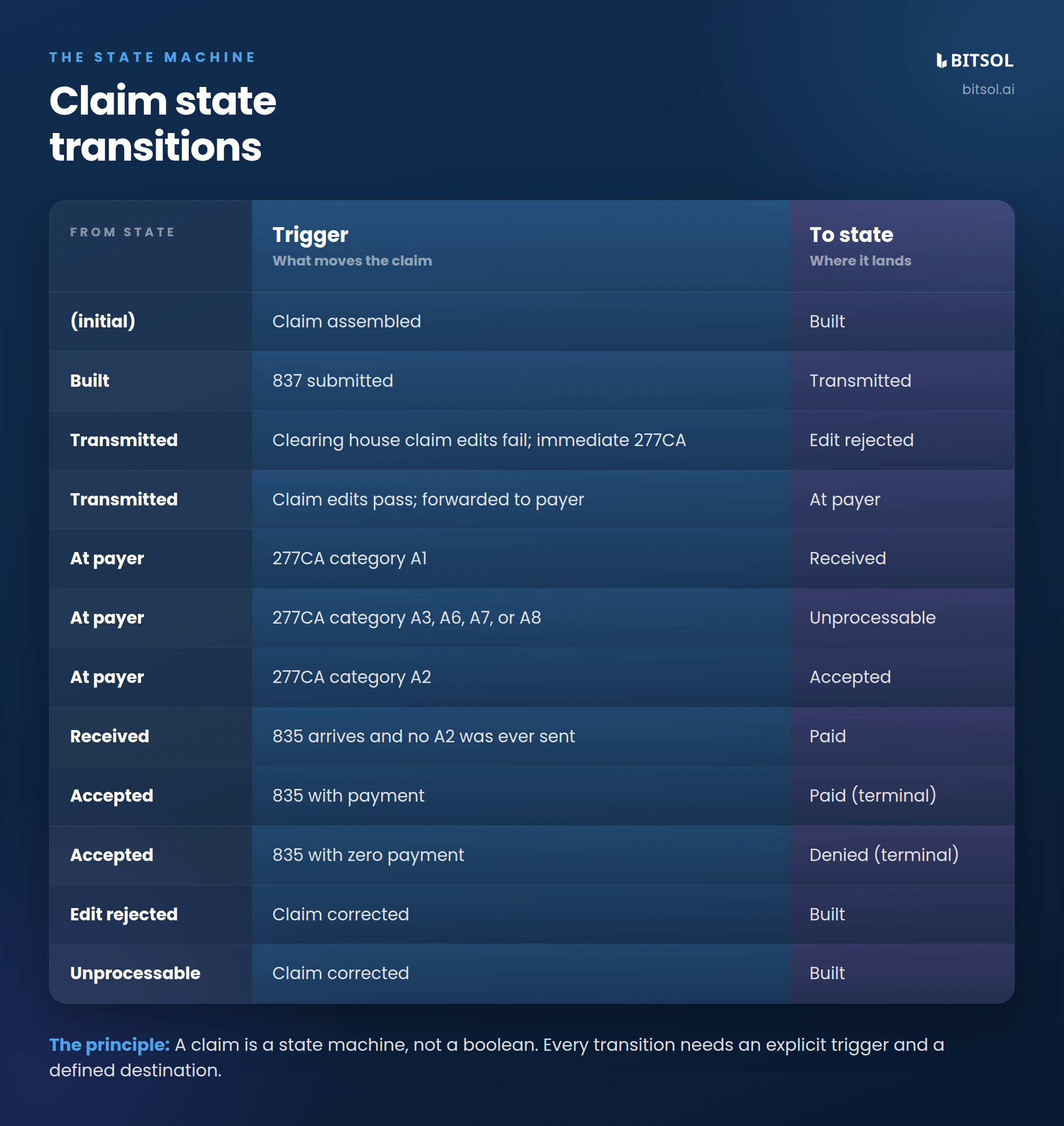
Two correction loops return to the Built state, and one path runs from Received directly to Paid to accommodate payers that never issue an A2.
2. The four functions of a clearing house
Describing a clearing house as "an API for payers" understates its role. It performs four distinct functions.
Translation. Converts JSON to X12 and back, including the segment-level details that vary between payers.
Validation. Runs claim edits that catch a specific class of problem before it reaches a payer: structural errors, missing required segments, malformed code values, and unknown payer identifiers. Payer-specific business edits still apply downstream, and no clearing house catches all of them.
Routing. Maps a plan name to the correct payer identifier and connection, and tracks which payers require enrollment for which transaction types.
Reconciliation. Correlates an outbound claim with acknowledgments and remittances that arrive later, sometimes much later, and sometimes out of order. This is the function integrating teams most consistently underestimate.
3. Limitations: what the clearing house does not do
The following responsibilities remain with the integrating organization.
It does not guarantee payment. A clean claim submitted through a clearing house can still be denied.
It does not handle credentialing. Providers still require NPIs, taxonomy codes, and active enrollment with each payer. The clearing house does not establish any of these; it fails informatively when they are missing.
It does not complete transaction enrollment. See Section 4.
It does not own the fee schedule. The billed amount is the provider's decision, the paid amount is the payer's, and the difference is written off during adjudication.
It does not assess medical necessity or coding accuracy. A syntactically valid claim carrying an incorrect procedure code passes through and is denied.
It does not replace payer relationships. Contracts, rates, and appeals remain between the provider and the payer.
It does not remove the need for a signed Business Associate Agreement (BAA). Because PHI passes through the clearing house, HIPAA requires a BAA between the covered entity (or its business associate) and the clearing house before any live PHI is sent.
3.1 Transaction enrollment: the timeline killer
Enrollment is the requirement most likely to disrupt a project timeline, and it rarely appears in API documentation. Transaction types do not all become available at the point credentials are issued.
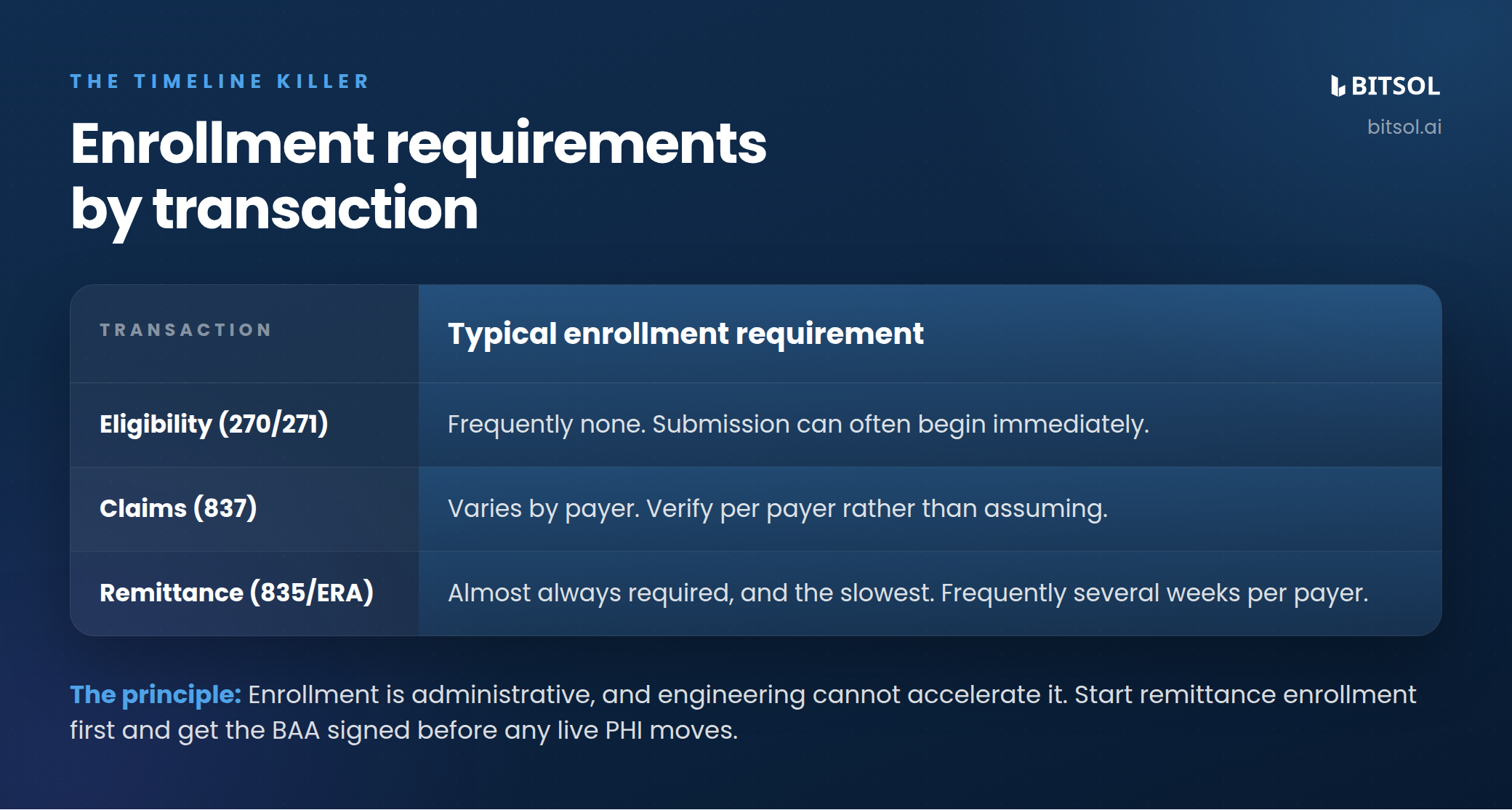
RECOMMENDATION — begin remittance enrollment in the first sprint rather than in the sprint that depends on it. The process is administrative, and engineering cannot accelerate it. Build the payment-ingestion path against test fixtures while the enrollment clears.
4. The benefits, for two audiences
For the provider
A single workflow. One interface replaces one browser tab per payer.
Coverage confirmed before the visit rather than after the denial. A real-time eligibility check converts a billing surprise into a pre-visit conversation.
Reduced time to payment. Electronic submission removes the postal and manual-keying stages, so a claim reaches adjudication the same day rather than the following week. Adjudication duration itself is unchanged: clean electronic claims are commonly paid within two to four weeks, and many states' prompt-pay rules set an outer bound. The gain comes from eliminating transport time and rejection round-trips, not from accelerating the payer.
Fewer rejections. Pre-submission validation catches malformed data — the class of failure in which a single transcription error otherwise costs a full billing cycle.
For the engineering team
No X12 stack to build and maintain. Segment ordering, loop hierarchies, envelope control numbers, and per-payer companion-guide deviations constitute a specialty. For most teams, acquiring that capability commercially is the correct decision. The exception is high transaction volume concentrated among a small number of payers, where direct connections can be less expensive than per-transaction pricing. At modest volume across dozens of payers, the comparison is not close.
New payers become configuration rather than code. Where payer identifiers, procedure codes, modifiers, and filing windows are held in seeded database tables rather than in conditional logic, supporting a new state or plan is a data change affecting one seed file rather than a development project.
A single audit surface. One integration point provides one place to log, encrypt, and enforce access control.
5. Design considerations: the failure modes to engineer against
The following are the failure modes the transaction set makes possible, and the required handling for each. This is where Healthcare APIs either earn their reliability or quietly lose money.
5.1 Soft failures that return a success status
Clearing houses commonly return business-level problems, such as member not found or payer temporarily unavailable, inside a 200 OK response body rather than as an HTTP error. Eligibility is the clearest case: AAA rejections typically return a 200 status, so branching on the status code alone records a member-not-found result as a success.
REQUIREMENT — parse the error array on every response, and map each error class to a distinct outcome.
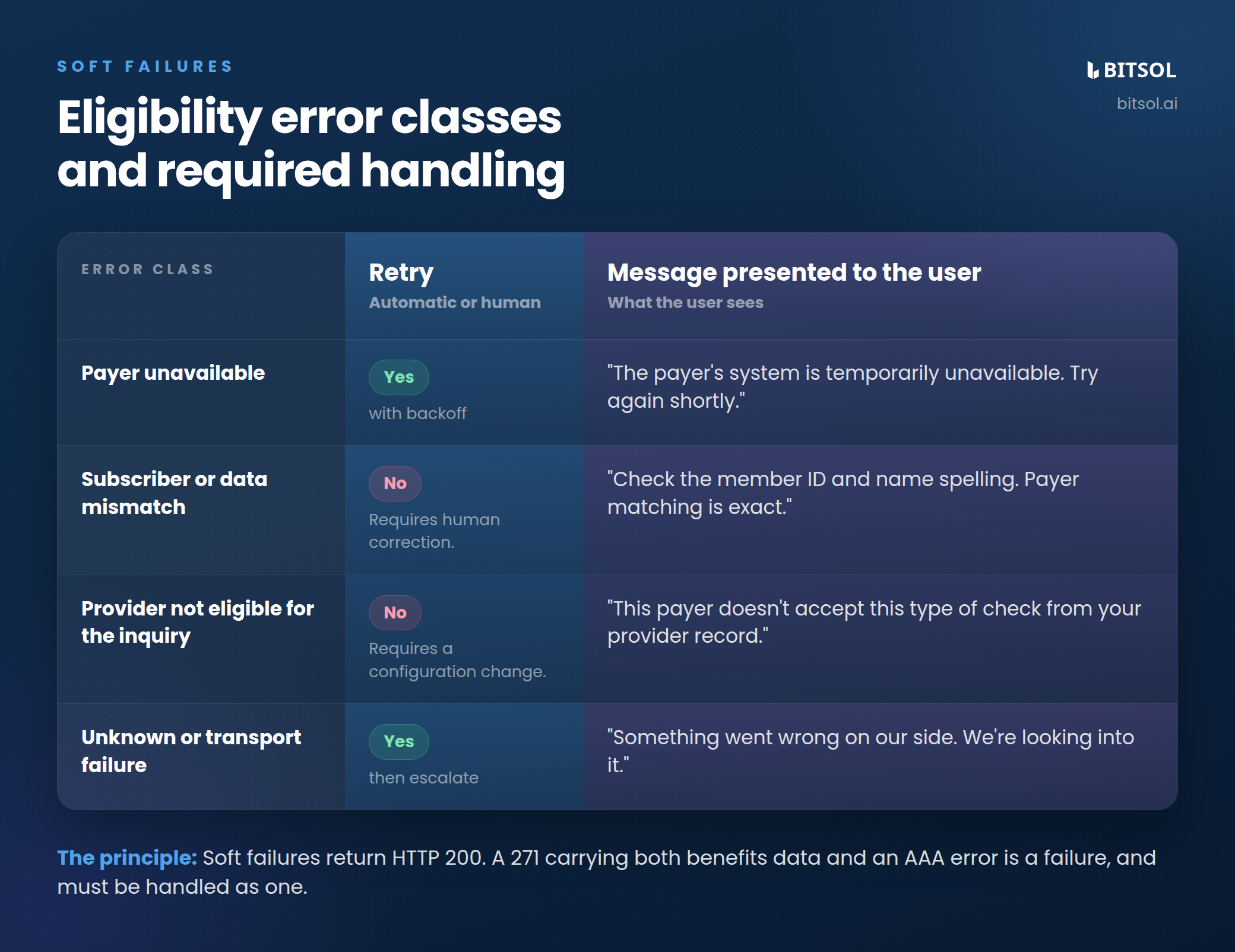
Raw codes belong in logs. Users receive plain language and a next step. Two rules follow from this table. First, the two middle classes are not retryable; retrying a data mismatch produces a retry loop that achieves nothing while consuming per-transaction fees. Second, an eligibility response containing both benefits data and an AAA error is a failure rather than a partial success.
5.2 Idempotency and duplicate claims
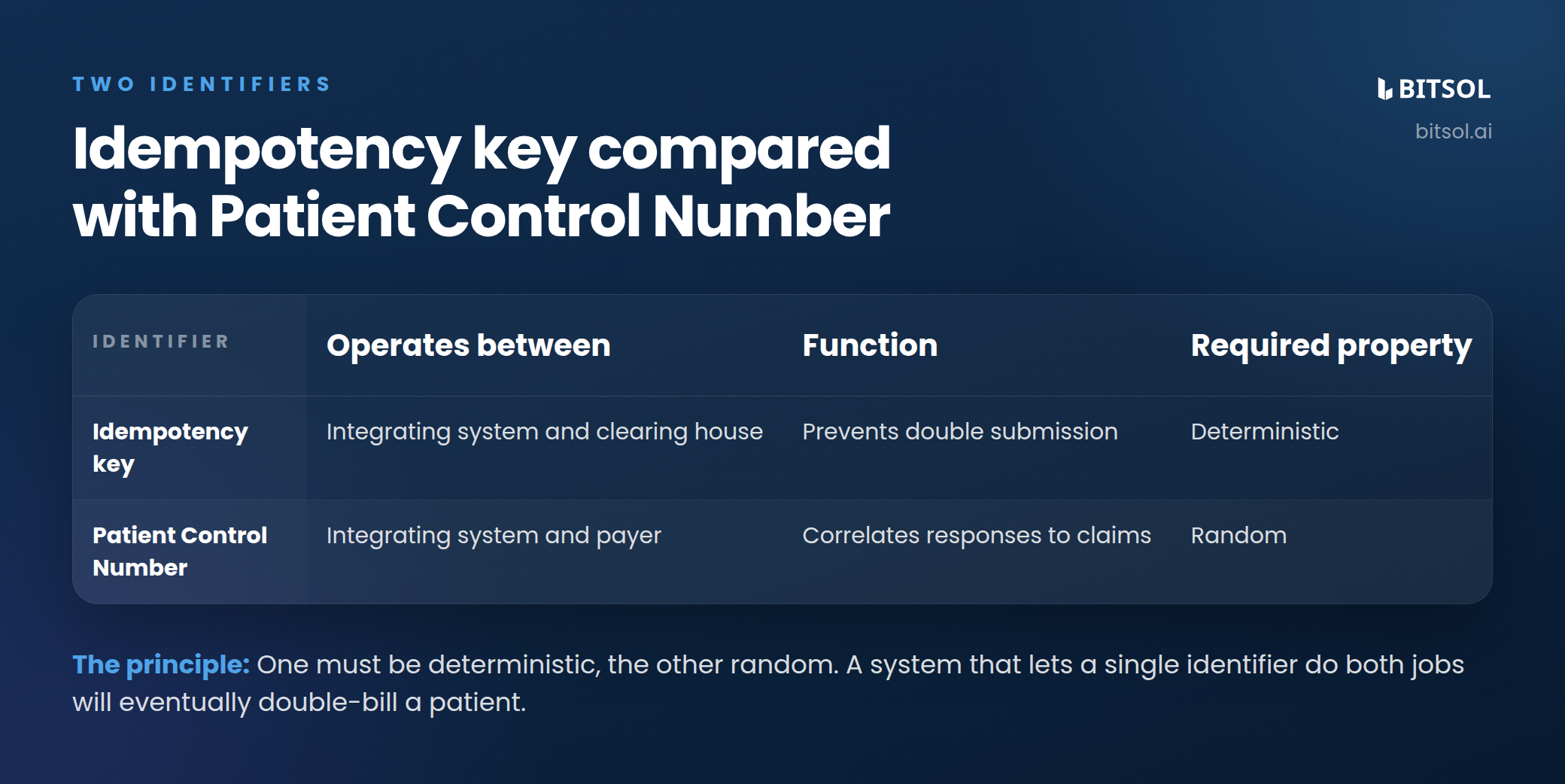
Every submission should carry a deterministic idempotency key derived from the claim's own identifier rather than a value regenerated per attempt. Where the connection drops mid-submission, a retry is then recognized as the same submission rather than as a second bill. Idempotency is only as strong as the determinism of the key: a randomly generated key per attempt provides no protection.
The constraint usually omitted is that the deduplication window is time-bounded. Twenty-four hours is a typical figure. A retry outside that window constitutes a new submission, and the payer will treat the second copy as a duplicate claim and deny it.
REQUIREMENT — implement duplicate detection independently of the intermediary's deduplication. This means a uniqueness constraint on the claim, plus a check across patient, service date, and service type that spans different claims rather than only line items within a single claim.
Note that two separate identifiers perform two separate functions here, and conflating them is a defect.
5.3 Protected health information and security
All data moving through this integration is protected health information, which makes Healthcare Data Security a design constraint rather than a review checklist.
A Business Associate Agreement (BAA) with the clearing house is a legal requirement, not just an implementation detail. Make sure the agreement is fully executed before transmitting any live PHI, including during testing if real patient data will be used.
Keep the API key server-side. The client application must never contact the clearing house directly.
Encrypt identifiers at rest, including member identifiers, legal names, and dates of birth. Accept the consequence deliberately: randomized encryption is not searchable, so lookups must run on internal record identifiers rather than on member identifiers. Where lookup by identifier is genuinely required, the mechanism is a blind index — a separate design decision carrying its own disclosure tradeoffs, not suitable for retrofitting.
Exclude PHI from logs. Log payer identifiers, transaction identifiers, timings, and error codes. Never log member identifiers, names, or dates of birth. This restriction extends to error-tracking payloads — the most common source of accidental disclosure — and to request URLs, since identifiers placed in query strings reach access logs, proxy logs, and browser history.
Audit every read and write declaratively, so that a newly added endpoint cannot silently bypass the audit trail.
Verify inbound webhook signatures before the request body is parsed or persisted, using a constant-time comparison. A public endpoint that mutates claim state is exactly as trustworthy as its signature verification.
6. Measuring the result
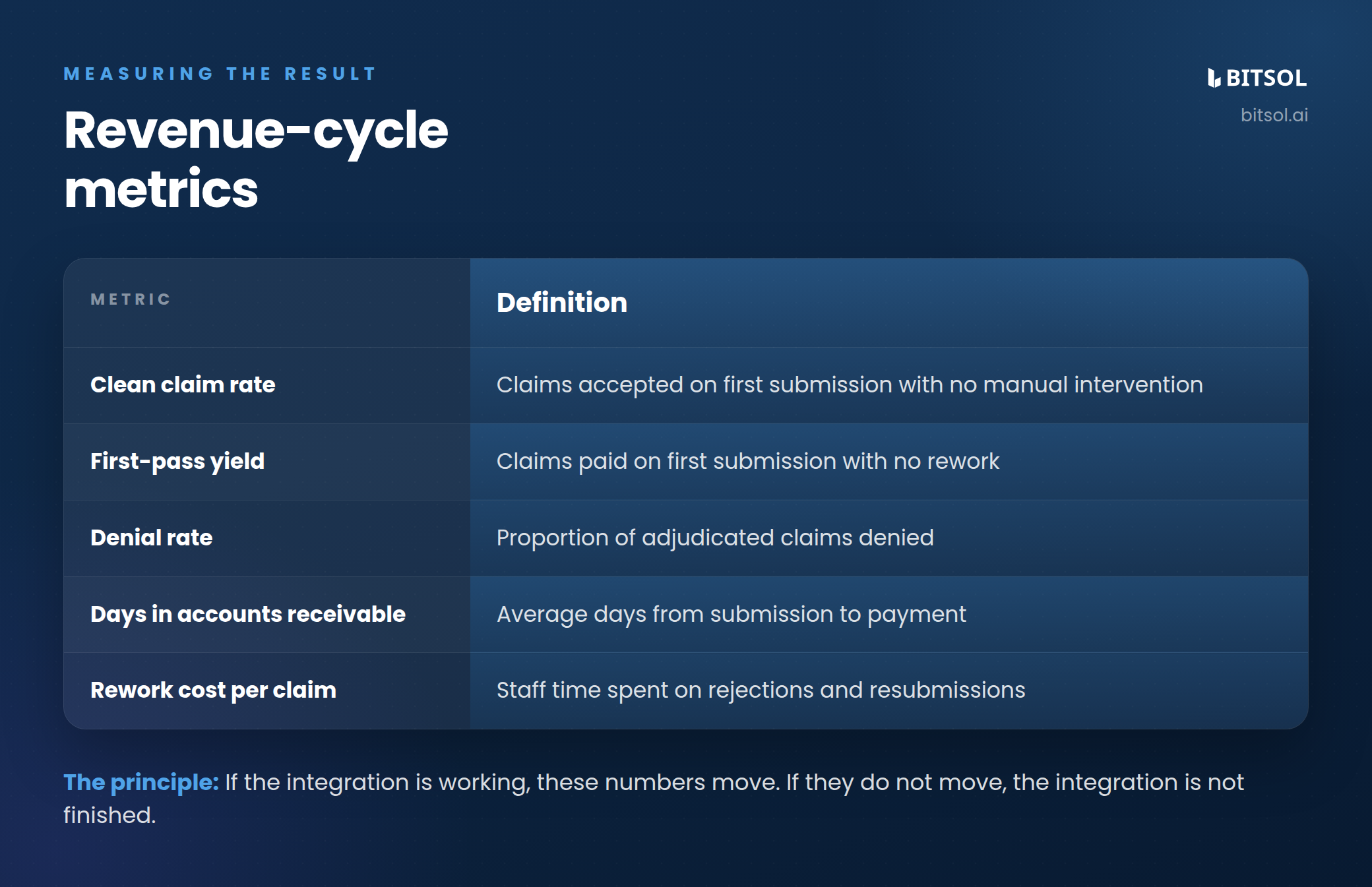
The following are the standard metrics for this domain and the appropriate basis for assessing whether a clearing house integration delivered value. This is also where Health Data Analytics pays off — these metrics only exist if the integration captures state cleanly.
For an organization building software for providers, the distinction is between a product that documents care and one that makes care financially sustainable for the people delivering it. Billing infrastructure is unglamorous, and it frequently determines whether a small practice can remain open.
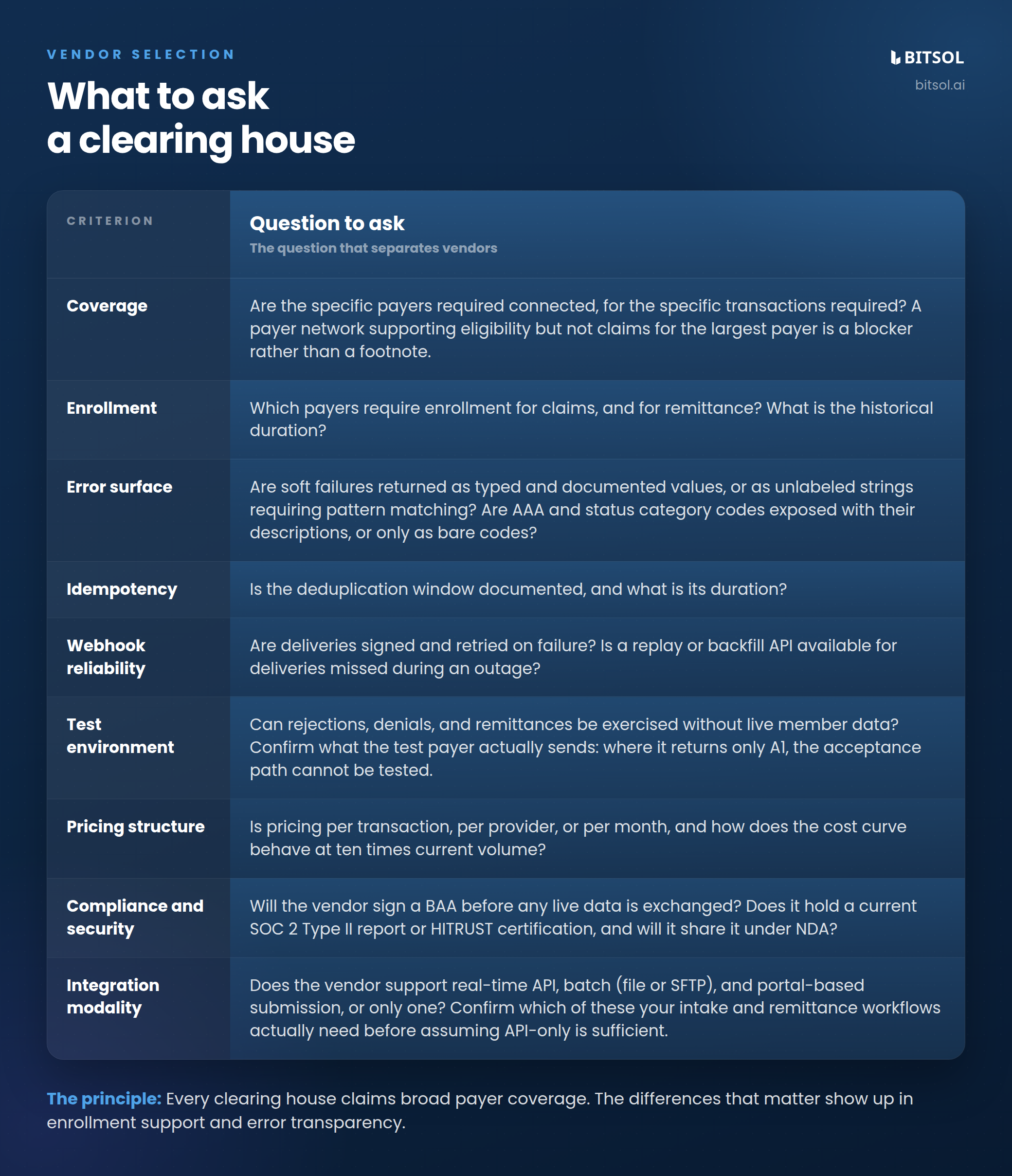
7. Selecting a clearing house
The following questions differentiate clearing house vendors in practice.
How Bitsol builds billing infrastructure that holds up
An integration that survives production is less about the happy path and more about the dozen ways the transaction set can fail quietly — the A1-that-never-becomes-A2, the AAA error hiding inside a 200 OK, the remittance that arrives before the acknowledgment. This is the work Bitsol does. Our Healthcare APIs team designs the asynchronous, webhook-driven reconciliation layers that clearing house integrations demand, with idempotency and duplicate detection built in rather than bolted on. Because every transaction carries PHI, we build to HIPAA-compliant standards from the architecture up — encryption at rest, PHI-free logging, and audited access as defaults, not exceptions. If your team is planning a clearing house integration or trying to lower a stubborn denial rate, let's map the path together →.
Conclusion and key takeaways
A clearing house integration is not a feature you ship once; it is a durable system that has to stay correct across weeks-long, out-of-order, occasionally-silent payer conversations. The teams that succeed treat asynchronicity, distinct outcome states, and PHI handling as design constraints from day one — and start the administrative work, enrollment and the BAA, before engineering depends on it.
The essentials, distilled:
Treat the clearing house as a hub, not a pipe. It replaces N × M direct payer integrations with N + M, and it translates, validates, routes, and reconciles.
Expect information about money, not money. Funds move separately by EFT on a separate enrollment track, reassociated with the 835 via a trace number.
Map each transaction to its expected arrival time. 270/271 within seconds, clearing house edits within seconds, payer 277CA within minutes to days, and 835 within days to weeks. Most design errors originate in expecting the wrong response at the wrong time.
Do not treat A1 as A2. Some payers acknowledge receipt and never issue acceptance, so a remittance must be able to close a claim on its own.
Model rejection and denial as distinct outcomes. They arrive on different transactions, require different resolutions, and carry different costs.
Parse the error array on every response. Soft failures return HTTP 200, and a 271 carrying both benefits data and an AAA error is a failure.
Separate the two identifiers. The idempotency key must be deterministic and guards against double submission within a bounded window. The Patient Control Number must be random, alphanumeric, and no longer than 17 characters.
Start remittance enrollment first, and get the BAA signed before any live PHI moves. Both are administrative, and engineering cannot accelerate either.
Hold payer-specific values in configuration. Where a new payer is a data change, the system scales without re-engineering.
Treat PHI handling as a design constraint rather than a review checklist. Encrypt at rest, exclude identifiers from logs and URLs, audit every access, and verify every signature before parsing.
The best infrastructure is the kind nobody notices. Implemented correctly, the providers using your software will never encounter EDI transaction sets, payer identifiers, or acknowledgment codes — they will simply get paid, on time, and stay open to see the next patient.
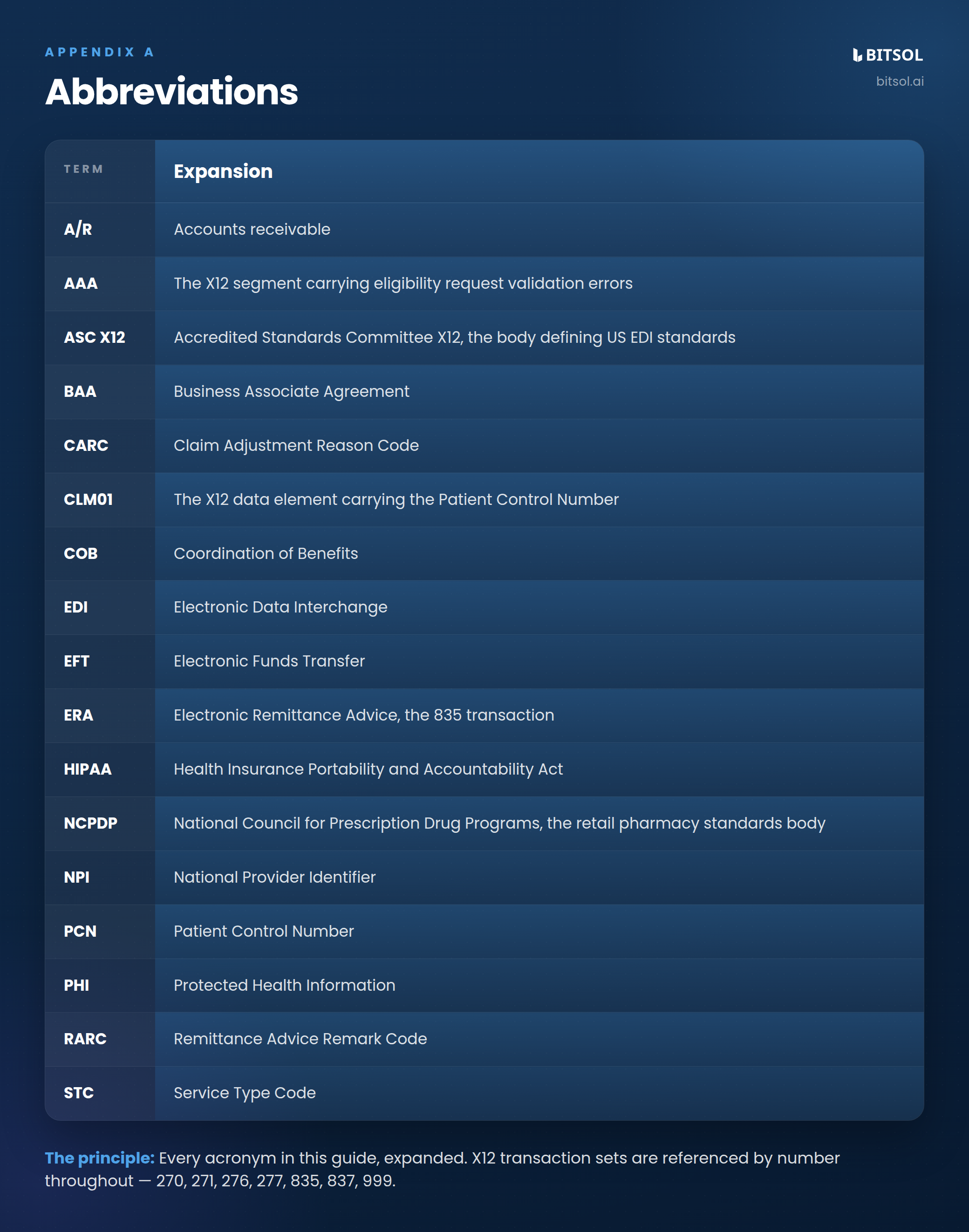
Appendix A. Abbreviations
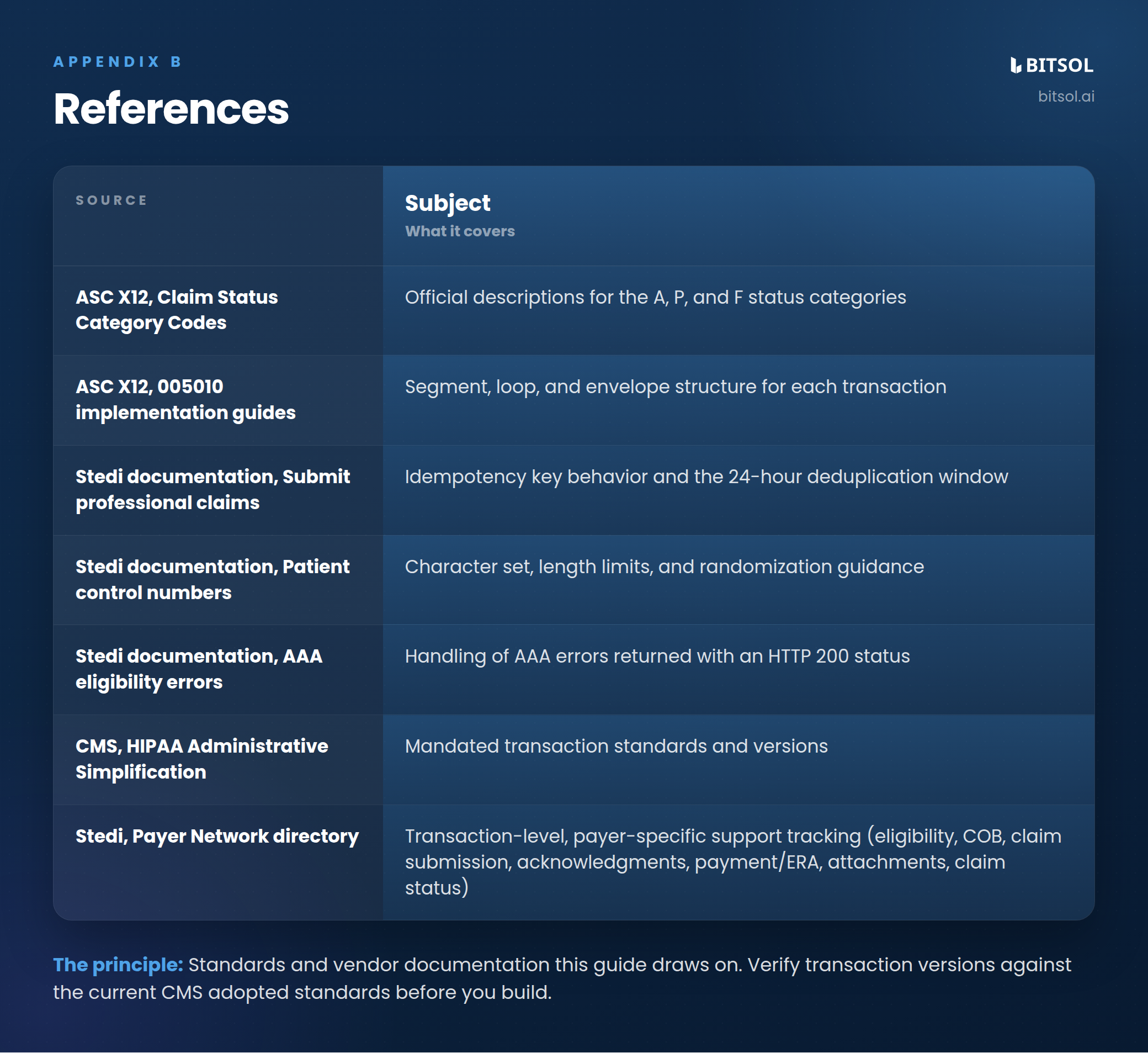
Appendix B. References