A patient who leaves the clinic with a prescription has made a plan. Whether they follow it is a different question, and for most care teams it is the one they can see least. The World Health Organization has said that in developed countries, adherence to long-term therapy among people with chronic disease averages only 50%. A reminder app does not close that gap on its own. Medication adherence software has to find out what actually happened, tell the right person in time, and respect the fact that the data is protected health information.
This guide covers what that software does, the features that matter, how to measure adherence so the numbers hold up, and the compliance and integration decisions to make before you build. It is written for HealthTech founders, product leads and clinical operations teams who are choosing between buying a tool and building one.
What medication adherence software actually does
Good adherence software does four jobs, and most weak products only do the first.
Prompt. It reminds the patient at the right time, in the channel they use, and adapts when the schedule changes.
Record. It captures whether the dose was taken. Self-reported taps are the weakest evidence. Stronger signals include a video of the dose, a smart-device event, a pharmacy refill record or a scan.
Alert. It tells a person (a nurse, a caregiver, a pharmacist) when a dose is missed or a pattern is forming, while there is still time to act.
Report. It turns the record into measures a clinical or program team can use: who is falling behind, since when, and what happened after an intervention.
Who buys it, and what each buyer needs
The same word covers very different products. A provider group wants a way to verify adherence and trigger follow-up between visits. A pharmacy wants refill timing and outreach. A health plan or employer program wants population-level measures. A digital health company wants an adherence layer inside its own product, so patients stay engaged. Each buyer defines success differently, so decide which one you are building for before you choose features.
Features that change behaviour
Reminders that are specific, not generic
A notification that says "take your medication" is easy to ignore. Reminders that name the medication, fit the patient's daily routine and stop when the dose is logged cause less fatigue. Let patients and caregivers set quiet hours and escalate only when a dose is actually missed.
Dose verification
If a decision depends on knowing the dose was taken, a tap is not enough. In one Bitsol build for a confidential client, patients submit a short video as proof of the dose, and the care team gets real-time alerts on missed doses and a dashboard for planning interventions. The product went from concept to production in 8 weeks. You can read the details in the medication adherence and tracking tool case study.
Drug identification and a single medication list
Patients and caregivers often cannot say what is in the cabinet. Barcode scanning with instant drug identification, plus a shared medication list for the patient and a caregiver, removes a common source of error. Our smart medication management suite was built this way, with separate patient and caregiver views.
Device data
For treatments that depend on a device, adherence is about wear or use, not a pill. A Bitsol build for a confidential client tracks wear time automatically over Bluetooth, with real-time adherence analytics and remote firmware updates, so providers can see whether patients are using the device as prescribed. See the orthodontic treatment monitoring hub.
Caregiver and clinician views
Adherence is often managed by someone other than the patient. Build role-based views early: what a caregiver may see, what a nurse sees, and what the patient has agreed to share. Consent and access rules are much harder to add after launch.
How to measure adherence so the numbers hold up
Pick the measure before you build the dashboard, because the measure shapes the data you must capture.
Proportion of days covered (PDC) is built from refill or dispensing records and estimates the share of days a patient had medication on hand. It is widely used in quality programs, and a threshold of 80% is a common line between adherent and non-adherent in those programs. It tells you about supply, not about whether a dose was swallowed.
Dose-level events come from your own product: a verified dose, a skipped dose, a late dose. They give you timing, which supply-based measures cannot.
Outcome signals such as readings, symptoms or visit attendance help you check whether better adherence is changing anything.
Most programs need more than one. Be clear in the product about which one each chart shows, because a supply-based number and a verified-dose number can disagree, and both can be right.
Analytics that lead to an action
An adherence dashboard is useful when each view ends in a decision. Useful views include patients who missed two or more doses this week, patients whose adherence has dropped over four weeks, the time between a missed dose and a human follow-up, and the response rate to each type of outreach. A chart that only shows an overall percentage rarely leads anyone to do anything.
Compliance: does HIPAA apply to your adherence product?
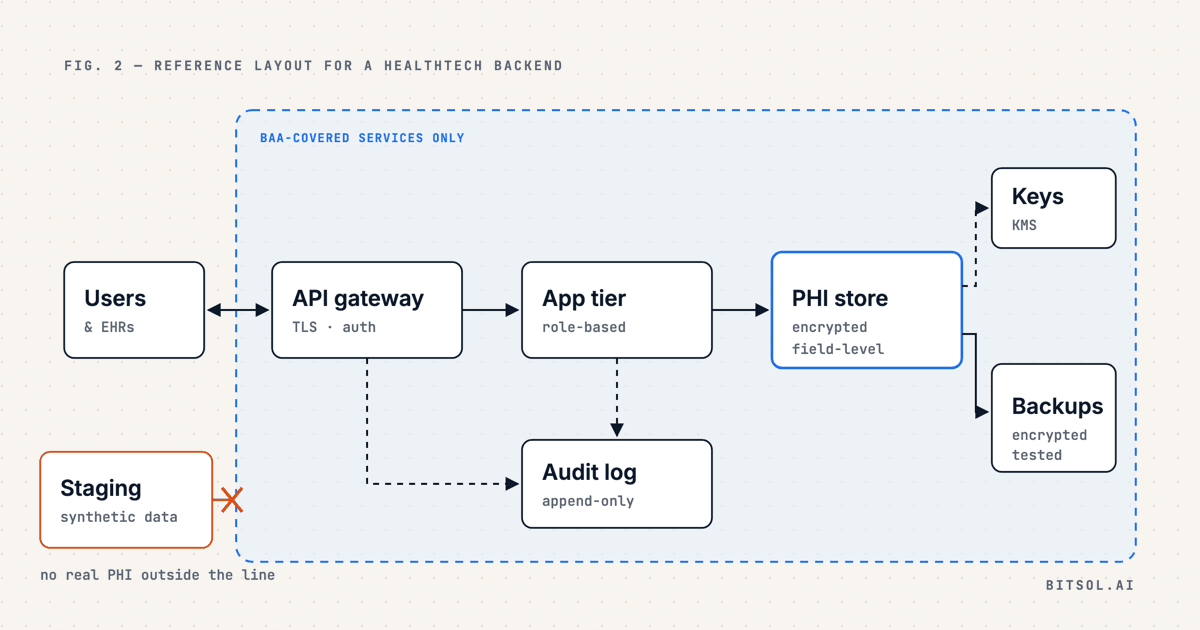
If you build for a provider, a pharmacy or a health plan, or you handle data on their behalf, you are likely a business associate, and HIPAA applies to the data you hold. That means a signed Business Associate Agreement, encryption in transit and at rest, access control, and audit logs. The details are in our guides on what a BAA must cover and the six controls of a HIPAA-compliant backend.
If you sell directly to consumers with no provider relationship, HIPAA may not apply, but you are not unregulated. The FTC's Health Breach Notification Rule, amended in 2024, covers health apps outside HIPAA and treats an unauthorized disclosure as a breach, not only a hack. Our guide on whether HIPAA applies to your app walks through how to tell which side you are on. Video, photos and device data are all health information once they are tied to a person, so plan for them from the start.
Integration decisions
An adherence tool that lives alone gets ignored. Decide early where it needs to connect: the EHR, so clinicians see adherence in their usual workflow; pharmacy or refill data, so you can use supply-based measures; wearables and devices; and the patient's phone, for notifications and camera access. For the EHR side, our EHR API integration guide explains FHIR data, patient consent and webhooks, and the guide to HIPAA-compliant API design covers the controls to build into each connection.
Build or buy
Buying makes sense when a standard reminder and refill workflow fits your program. Building makes sense when your adherence signal is unusual (a device, a video, a specialty therapy), when you need the data to live in your own cloud account, or when adherence is the core of your product rather than a feature. If you build, scope the first release around one signal and one action, ship it to a small group of real patients, and expand from there.
How Bitsol approaches adherence products
Bitsol builds healthcare software only, with HIPAA compliance designed in from the first sprint and 50+ healthcare products shipped. For adherence work that usually means a focused first release: a patient app, a care-team view, alerts, and the integrations that matter, with the client owning the code and the cloud account. If you are weighing a build, the team can talk through your adherence signal and what the first release should include. See our medication management app development work, start with our HIPAA compliant software development page, or look at how we run an 8-week HIPAA-compliant MVP launch.
Frequently asked questions
What is medication adherence software?
It is software that helps patients take medication as prescribed and helps care teams see whether they did. It combines reminders, a record of doses taken, alerts when doses are missed, and reporting for clinicians or program managers.
How do you measure medication adherence?
Programs commonly use proportion of days covered, which is based on refill records, and dose-level events recorded in the product, such as verified or missed doses. Many programs use both, because supply and actual dosing can differ.
Does a medication adherence app need to be HIPAA compliant?
If it handles protected health information for a provider, pharmacy or health plan, yes. If it is sold directly to consumers without a provider relationship, HIPAA may not apply, but the FTC Health Breach Notification Rule and state health privacy laws may. Building to HIPAA standards is the safer default.
Can medication adherence software connect to an EHR?
Yes. Most EHRs expose patient data through FHIR APIs, so an adherence tool can read medications and write adherence summaries back. The work is in patient consent, data mapping and secure connections.
How long does it take to build a medication adherence app?
It depends on the signals and integrations. Bitsol took a medication adherence and tracking tool for a confidential client from concept to production in 8 weeks. The scope that fit that timeline was one verification method, real-time alerts and an analytics dashboard.