Building a HealthTech app is not the same as building a consumer app with a compliance checklist added at the end. The data is protected, the buyers are cautious, the integrations are old and varied, and a mistake in the first release can end a security review before it begins. Teams that ship well make a small number of decisions in the right order. This guide sets out those decisions, from choosing the product type to launching a first release, for founders, product leads and technology teams planning a HealthTech app.
Start with the type of HealthTech app
The type of product decides who the user is, which laws apply and what the build looks like.
Patient-facing apps include telehealth, symptom and condition management, medication support and women's health products. Adoption depends on onboarding and trust. Our post on why HealthTech onboarding loses patients shows where patients drop out.
Clinician-facing tools include documentation aids, decision support and care coordination. They live or die on fitting into the existing workflow, usually inside or beside the EHR.
Remote monitoring and device apps combine wearables or devices with analytics and alerts.
Operations and revenue tools include billing, claims and scheduling. Integrations with payers and clearing houses dominate the work. See our guide to clearing houses and X12 transactions.
AI products sit across all of the above and add questions about where PHI goes, which model sees it and how a clinician stays in control.
Many products span two types. Pick the one that has to work first, and build that.
Settle the compliance question before the design
The first compliance question is whether HIPAA applies. If you handle protected health information for a provider, plan or other covered entity, you are likely a business associate and need a BAA, encryption, access control and audit logging, plus a documented way of working. If you sell directly to consumers with no provider relationship, HIPAA may not apply, but you may fall under the FTC's Health Breach Notification Rule or state consumer health data laws. Our guide on whether HIPAA applies to your app explains how to tell.
The second question is whether your software is a medical device. That turns on your claims. General wellness claims are treated differently from claims to diagnose, monitor or manage a disease, and the FDA updated its guidance on general wellness and clinical decision support software in January 2026. Settle this before you write product copy.
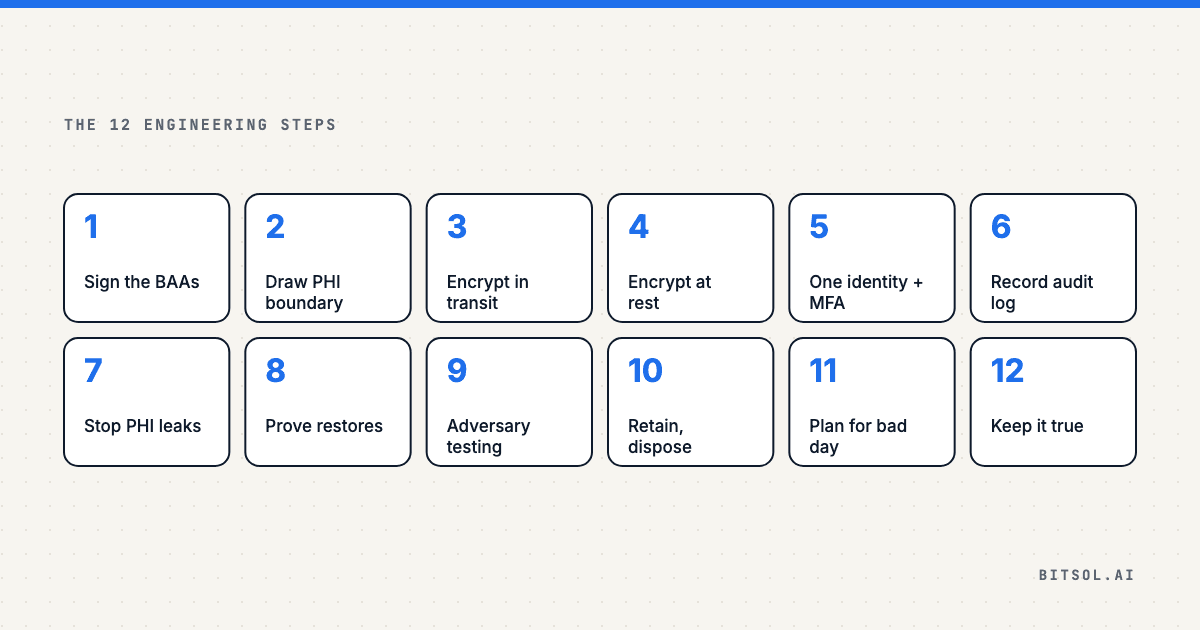
If HIPAA applies, the practical path is laid out in how to develop a HIPAA-compliant application: the 12 engineering steps. Two foundations are worth reading early: what counts as PHI and the 18 HIPAA identifiers, and what a BAA must cover.
Plan integrations early
In healthcare, an app that cannot exchange data usually does not get adopted. Decide which systems you must connect to for the first release, and which can wait. Common connections are EHRs through FHIR APIs, patient-authorized record access, wearables and devices, labs, pharmacies and payers. Each one brings consent rules, data mapping and a partner with its own timeline.
Our EHR API integration guide covers FHIR data, patient consent and webhooks. The guide to HIPAA-compliant API design covers the controls every connection needs. Bitsol's EHR integration service page explains how we approach the work.
Design the architecture around PHI
The most expensive compliance work is retrofitting. Decide at the start where protected data lives, what can see it, and what must never touch it. In practice that means BAA-covered hosting, encryption, role-based access, audit logs, separated non-production environments, tested backups and a clear list of vendors that handle PHI. The six controls are set out in our guide to HIPAA-compliant backend architecture. For founders weighing this against speed, building HIPAA-compliant software from day one explains what actually differs between an MVP and an enterprise build.
Scope a first release that can ship
A first release should prove one thing to one type of user. A workable scope has one primary user journey, the two or three integrations that make your data useful, role-based access, the compliance controls in place from the first week, and an analytics view that shows whether the core behaviour is happening. Leave out secondary roles, broad reporting and anything that depends on a partner who has not signed.
With that scope, a focused build can reach production in weeks. Bitsol builds HIPAA-compliant MVPs in 8 weeks: the Doulio platform had a working prototype in week one and was BAA-ready by week eight, and the VillageFor perinatal mental health app reached the App Store in 8 weeks. Timelines slip when scope widens, when a regulatory claim is unsettled, or when compliance is treated as a phase at the end. See our post on why HealthTech products fail and how early validation helps.
What drives the cost
Cost depends on scope, not screen count. The factors that move it most are the number and type of integrations, whether AI is involved, the regulatory path, the number of user roles, and how much needs to be built for clinicians as well as patients. Ask any partner for a written estimate against a fixed feature list, and be wary of a fixed quote given before discovery.
Choosing a development partner
A good partner will answer specific questions: how they handle BAAs and subprocessors, how PHI is separated in development, what they have shipped in your category, who owns the code and the cloud account at the end, and how they will keep supporting the product after launch. Our guide on how to choose a HIPAA software development company lists seven questions, and our comparison of HIPAA-compliant app development companies for startups shows how partners differ.
Examples by category
For women's health, see our guide to FemTech app development. For adherence and medication management, see medication adherence software. For AI, Thymos Health built a patient-question chatbot that answers from real EHR data with no PHI sent to third-party models, and passed an enterprise security review on the first attempt. See the Thymos Health case study.
How Bitsol approaches HealthTech app development
Bitsol builds healthcare software only, with 50+ healthcare products shipped. We design HIPAA compliance into the first sprint, scope integrations at the architecture stage, and hand over the code and the cloud account to the client. If you are planning a HealthTech product, explore our HIPAA compliant software development approach and our 8-week HIPAA-compliant MVP launch.
Frequently asked questions
What is HealthTech app development?
It is the design and build of software for healthcare, including patient apps, clinician tools, remote monitoring, billing and operations software, and AI products. It differs from general app development because of privacy law, regulatory claims and integration with clinical systems.
How long does it take to build a HealthTech app?
It depends on scope and integrations. A focused, HIPAA-compliant first release can reach production in 8 weeks. Broader scope, unsettled regulatory claims and partner integrations extend that.
Does my HealthTech app need to be HIPAA compliant?
If it handles protected health information on behalf of a provider, plan or other covered entity, yes. If it is sold directly to consumers without a provider relationship, HIPAA may not apply, but the FTC Health Breach Notification Rule and state laws may. Many teams build to HIPAA standards anyway because partners and enterprise buyers expect it.
What drives the cost of a HealthTech app?
Scope, not screen count. The biggest factors are the number of integrations, whether AI is involved, the regulatory path, the number of user roles, and the clinician-facing features. Ask for a written estimate against a fixed feature list.
Can a HealthTech app connect to an EHR?
Yes. Most EHRs support FHIR APIs, and patient-authorized record access is also possible. The work is in consent, data mapping, security and each partner's onboarding process.