Most HealthTech founders plan the build in detail and the launch in a sentence. The app ships, the store listing goes live, and the first week brings a few dozen installs from friends and investors. Paid acquisition looks like the only way out, and for a pre-revenue team it is usually the wrong one.
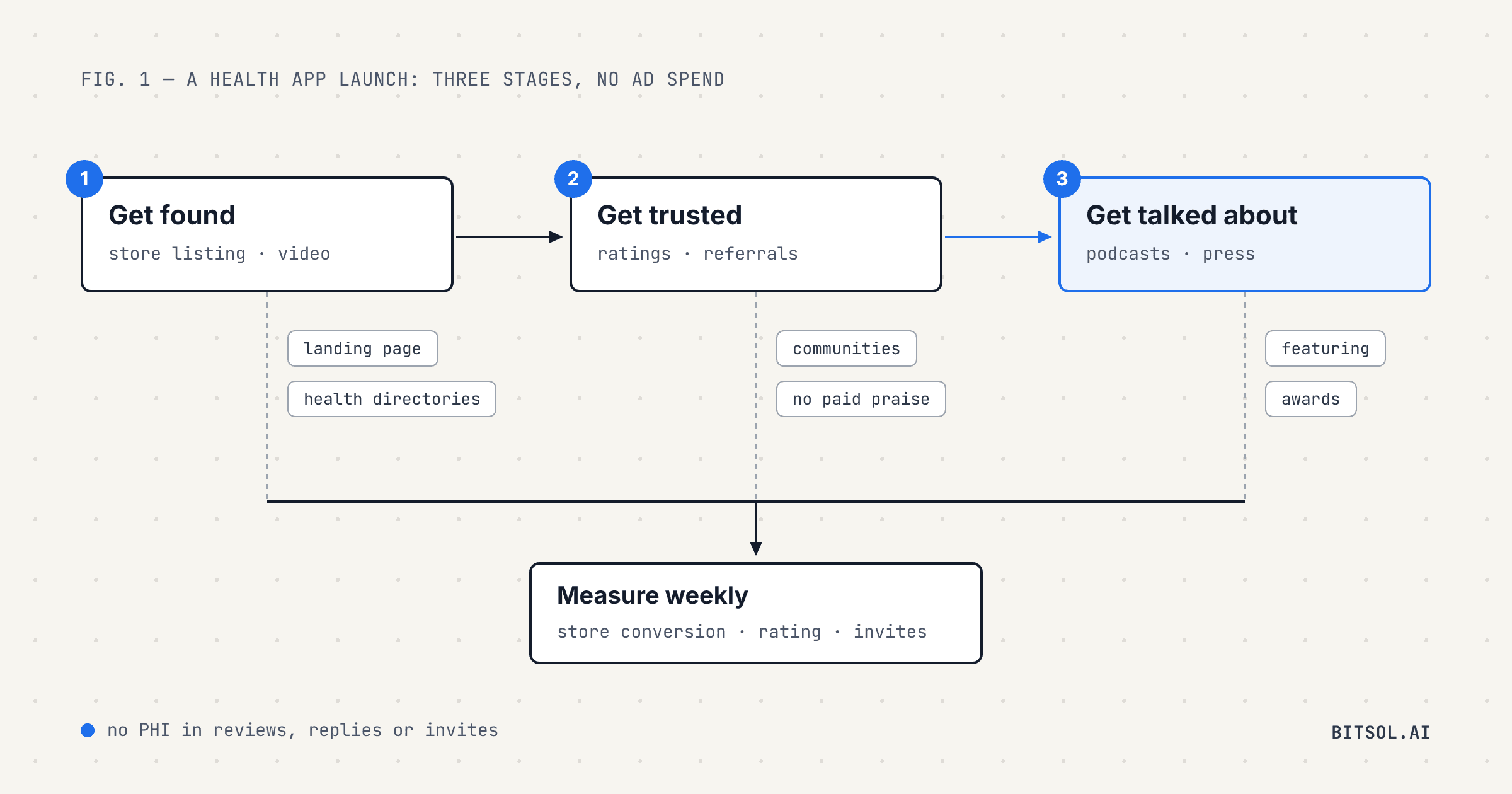
There is a cheaper route. It costs time instead of ad spend, and it works in three stages: get found, get trusted, get talked about. This guide walks through each stage, and it flags the places where a health app has to play by stricter rules than a consumer app does.
Why a HealthTech app cannot copy a consumer launch
The usual free-promotion advice was written for games, productivity tools and delivery apps. Three things change when the product handles health information.
Your users may be patients. If your company is a covered entity or a business associate, a review, a testimonial or a referral can contain protected health information. Our guide on whether HIPAA applies to your app covers how to tell.
Trust decides the install. People will try a photo editor on a whim. They will not hand over symptoms, cycle data or medication lists without a reason to believe you.
The buyer is often not the user. A clinic, an employer or a health plan may choose the app, and a patient or clinician uses it. Your promotion has to reach both.
None of this makes free promotion harder. It changes which tactics come first.
Stage one: get found
Treat the store listing as a search page
Search is where most installs start. In December 2025 Apple said that nearly 65 percent of App Store downloads happen directly after a search. If your listing does not match the words people type, nothing else in this guide can compensate.
The space is small, so every field matters, and the two stores read it differently. On the App Store the app name and the subtitle are each limited to 30 characters, and the hidden keyword field to 100. Google Play has no keyword field. Its store listing has a 30-character app name, an 80-character short description and a full description of up to 4,000 characters, so the words people search for have to appear naturally in the text. In both stores, put the plain description of what the app does up front: "medication reminders", "pelvic floor exercises", "blood pressure log". A brand name that nobody has heard of earns no searches.
Screenshots carry the rest. Show the three screens a new user reaches in the first minute, with a short caption on each. Use sample data only. A real patient's name in a screenshot is a disclosure, not a design choice. Both stores let you test this: Google Play with store listing experiments, the App Store with product page optimization. Test one change at a time, starting with the first screenshot.
Record a short preview video
Apple allows up to three app previews for each language, each up to 30 seconds. Google Play takes one preview video, added as a YouTube link. One good clip covers both. Record a single real task from start to finish, such as logging a reading and seeing the trend. Reuse the same clip on your landing page and in every pitch email.
Fill in the store privacy and health declarations properly
Both stores now show how an app handles data before anyone installs it. Apple requires App Privacy details to submit an app or an update, and Google Play requires a Data safety section. Google Play also requires every published app to complete its Health apps declaration in Play Console, a requirement in force since August 31, 2024. For a health app these forms are not paperwork. They are the first trust signal a cautious user sees. Fill them in from what the app actually collects, and keep them in step with every release.
Build one landing page
Journalists, podcast hosts and clinic managers will not link to a store listing. They link to a web page. It needs one headline that says who the app is for, the preview video, the store buttons, and a short section on how you protect data. If you sign a business associate agreement, say so. If you hold a security certification, name it. That section does more for a health app than any testimonial.
List where your buyers already look
General app directories bring little. Health-specific listings bring more: the app marketplaces run by EHR vendors, digital health libraries kept by professional bodies, and the resource pages of patient associations in your condition area. Each has its own submission rules, and several will ask for evidence. Have a one-page summary of your clinical basis and your privacy practices ready before you apply.
Stage two: get trusted
Ask for ratings at the right moment, within the rules
Ratings affect both ranking and the decision to install. Apple's ratings guidance lets you show the system rating prompt up to three times in a 365-day period and advises asking when users are most likely to feel satisfied, such as after they complete a task. For a health app that moment is a finished streak, a completed program week or a successful refill, never the middle of logging a symptom.
Google Play's In-App Review API has its own rules. Google limits how often a user sees the review card and does not publish the limit, so do not put the request behind a button. And your app must not ask any question, such as whether the user likes the app, before or while showing the card. The common trick of asking that question first and sending only happy users to the store goes against Google's guidelines.
Do not pay for praise. The FTC's rule on consumer reviews and testimonials, in effect since October 21, 2024, prohibits fake reviews and prohibits offering compensation on the condition that a review expresses a particular sentiment. "Leave us five stars for a free month" is the kind of offer the rule was written for. The FTC is now enforcing it: in December 2025 it sent warning letters to 10 companies and noted that violations can bring civil penalties of up to $53,088 each.
Reply to reviews without confirming anything
Both the App Store and Google Play let developers reply publicly to reviews, and in both the reviewer is notified and can update their review. Health teams need one extra rule: never confirm that the reviewer is a patient or mention anything about their care. In June 2023 a New Jersey mental health practice, Manasa Health Center, paid $30,000 to settle with the HHS Office for Civil Rights after its replies to negative online reviews disclosed patients' protected health information, including a mental health diagnosis and treatment details. A safe reply thanks the person, states your general policy and moves the conversation to a private support channel.
The same care applies to testimonials. HIPAA requires a patient's written authorization before their health information is used for marketing, as HHS explains in its marketing guidance. In September 2025 Cadia Healthcare Facilities paid $182,000 to settle with the HHS Office for Civil Rights after posting "success stories" about 150 patients, with names, photos and treatment details, without that authorization. Our explainer on the 18 HIPAA identifiers lists what counts.
Design a referral that does not expose the sender
Referral programs are one of the best-documented free growth channels. Dropbox reported growing from 100,000 registered users in September 2008 to 4 million in January 2010, with 35% of daily sign-ups coming through its referral program, which gave extra storage to both the person who invited and the person who joined.
A two-sided reward works for health apps too, with two changes. First, an invitation from a condition-specific app tells the recipient something about the sender, so keep the invite text generic and let the user decide what to say. Second, if your service is paid for by Medicare, Medicaid or another federal program, rewards for patient referrals can raise questions under the Anti-Kickback Statute and the beneficiary inducement rules. Ask a healthcare lawyer before you launch one.
Be useful in the communities your users are in
Patient forums, condition subreddits and clinician groups are where your users compare notes. Answer questions there for weeks before you mention a product, follow each group's rules on promotion, and say plainly who you work for. Do not give individual medical advice. The feedback you collect is worth as much as the installs, and it belongs in the same loop as your product validation work.
Stage three: get talked about
Podcasts and creators with clinical credibility
A health podcast with a few thousand listeners in your niche is worth more than a general tech show with fifty thousand. Pitch a topic, not the app: what you learned about adherence, what surprised you in user research. The same applies to creators. A nurse, physiotherapist or dietitian who actually uses the product is more persuasive than a large lifestyle account, and any paid or gifted relationship should be disclosed in the post.
Press and launch communities
Trade reporters in digital health want a number or a story, not a feature list. Lead with one finding from your pilot or one user's experience, told with their written permission. Keep a press kit on the landing page with screenshots, a founder photo and a two-line company description.
Launch communities such as Product Hunt reach early adopters and other builders rather than patients. They are still worth one well-prepared day for the feedback, the backlinks and the investor attention. Stay online and answer every comment.
Awards and store featuring
Digital health awards give a small team something reporters and buyers recognize. Pick two or three that judge on evidence, note the deadlines and reuse one submission.
Store featuring is no longer a matter of knowing an editor. On the App Store, Apple accepts nominations through Featuring Nominations in App Store Connect and asks for at least two weeks' notice, or up to three months for wider consideration. Its editors say they look at user experience, design, innovation, uniqueness, accessibility, localization and the quality of the product page. Accessibility is the factor health apps can win on, because their users include older adults and people with disabilities.
A 90-day order of work
Days 1 to 30: finish both store listings, the preview video and the landing page. Check the App Privacy details, the Data safety section and the Health apps declaration against what the app collects. Add the in-app rating prompt at one satisfying moment. Write your review-reply policy.
Days 31 to 60: start one store listing test, submit to health-specific directories, join two communities, pitch five niche podcasts and submit an App Store featuring nomination for your next release.
Days 61 to 90: turn on the referral program, run one launch-community day, send your pilot finding to trade press and enter one award.
Measure three numbers each week, for each store: store page conversion, average rating and the share of new users who arrived by invitation. If one stalls, fix that stage before adding a new tactic.
How Bitsol approaches a HealthTech launch
Promotion works when the product is ready for attention: stable, fast to onboard and clear about how it handles data. A launch that sends people to an app that crashes or loses them at sign-up spends your one free burst of attention on a bad first impression. Our post on why HealthTech onboarding loses patients shows where that happens.
Bitsol builds healthcare software only, with 50+ healthcare products shipped. We build launch readiness in from the first sprint, so the rating prompt, the referral flow and the privacy summary are part of the release rather than afterthoughts. The VillageFor perinatal mental health app went from concept to the App Store in 8 weeks, HIPAA compliant from day one. See the VillageFor case study.
If you are still planning the build, start with our guide to HealthTech app development. If you want a compliant first release in the stores quickly, see how our 8-week HIPAA-compliant MVP launch works.
Frequently asked questions
Can you promote a HealthTech app with no advertising budget?
Yes. Store search on the App Store and Google Play, ratings, referrals, communities and press all cost time rather than ad spend. Start with the store listings and word of mouth, because every other tactic sends people to them.
Can we offer rewards for app reviews?
You can ask for honest reviews. You cannot make a reward depend on the review being positive. The FTC rule in effect since October 2024 prohibits compensation conditioned on a review expressing a particular sentiment, and the FTC began sending warning letters under it in December 2025.
Can we use patient testimonials in our marketing?
If HIPAA applies to you, you need the patient's written authorization before using their health information in marketing. A provider paid $182,000 in 2025 for posting patient success stories without it. Even where HIPAA does not apply, get written permission and avoid claims about outcomes that you cannot support.
How should a health app reply to a negative review?
Thank the reviewer, do not confirm they are a user or patient, share no details about their account or care, and invite them to a private support channel. Providers have paid regulators settlements after disclosing patient details in public replies.
Is promoting on Google Play different from the App Store?
Yes, in three ways. Google Play has no hidden keyword field, so search terms belong in the title and descriptions. Its in-app review card has an unpublished limit and must not follow a question about whether the user likes the app. And every published app must complete the Health apps declaration in Play Console.
How far ahead should we ask Apple to feature our app?
Apple asks for a minimum of two weeks' notice through Featuring Nominations in App Store Connect, and recommends up to three months for wider featuring consideration.
Which free tactic should a HealthTech startup start with?
The store listings, on both the App Store and Google Play. They are where most people decide to install, every other tactic sends traffic to them, and improving them costs nothing but time.


