Six months after launch, a HealthTech founder asks a simple question: which features do patients actually use? The team can show download numbers, but not whether patients finish booking, which screens they abandon, or whether the last release helped. Often there is no product analytics at all, because nobody was sure what could be tracked in a health app without leaking patient data. Sometimes the opposite happened, and a standard marketing tag was added to logged-in screens.
Both outcomes are expensive. One leaves stakeholders guessing; the other can turn analytics into an unauthorized disclosure. This guide explains how analytics works in a health app and when a business associate agreement (BAA) is needed, and when it is not. It also covers which tools state that they sign one, and how to give stakeholders a dashboard they can act on. Requirements are linked to the regulation, the regulator or the vendor's own documentation, and our own recommendations are marked "we recommend."
What you will learn
Why stakeholders lose sight of their app after launch.
Why analytics carries more risk in health apps than in other apps.
When you need a BAA for analytics, and when you do not.
A five-step approach, from measurement plan to stakeholder dashboard.
Which analytics and crash-reporting tools state that they sign a BAA, and on which plans.
Why HealthTech stakeholders lose sight of their app
Three gaps usually cause it. First, there is no measurement plan: the app ships without agreed questions, such as "do patients complete intake?", or the events needed to answer them. Second, teams are unsure what is allowed, so they either add nothing or add the tools they use everywhere else. Third, even when events are collected, nobody turns them into a view a client or product owner can read, so the data exists but nobody gets answers.
Why analytics is riskier in a health app
Analytics tools work by sending events from the app to the vendor's servers. In a health app, those events can carry protected health information (PHI). HHS guidance says that tracking technologies on a regulated entity's user-authenticated webpages "generally have access to PHI." It also says that information collected by a regulated entity's mobile app "generally is PHI." The same guidance lists IP addresses and device IDs among the information that can be disclosed.
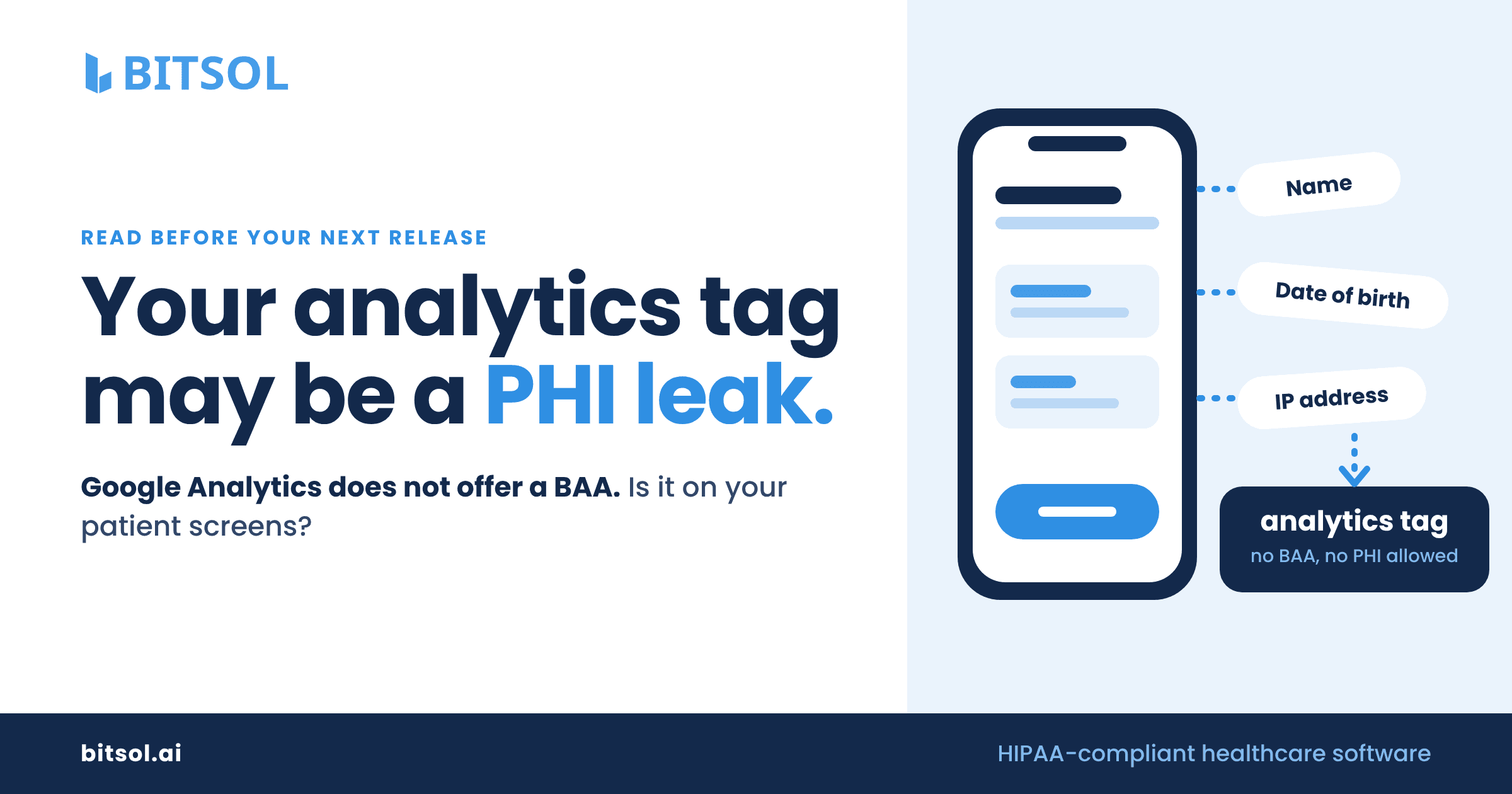
The FTC has acted against apps outside HIPAA too. In February 2023, GoodRx agreed to pay a $1.5 million civil penalty in the FTC's first enforcement action under its Health Breach Notification Rule, after the FTC said it had shared users' health information with companies including Facebook and Google. And Google states that it "does not offer Business Associate Agreements" for Google Analytics, and that HIPAA-regulated entities should not place its tags on authenticated pages, or on unauthenticated pages that are HIPAA-covered.
The shift: analytics has to be designed, not dropped in
Regulators now treat sending health data to a tracking vendor as a disclosure, not a technical detail. HHS says a privacy policy is not enough on its own, and that "website banners that ask users to accept or reject" tracking are not a valid HIPAA authorization. For apps outside HIPAA, the FTC says that disclosing covered health information without the person's authorization can be a breach under its rule, not only a hack. Part of HHS's tracking guidance was vacated by a federal court in June 2024, and HHS notes this on the guidance page. The vacated portion concerns tracking that links a person's IP address with a visit to a public, unauthenticated page about specific health conditions or health care providers.
The practical result is that the analytics setup is part of the product's compliance design. We recommend deciding it at the start of a build, together with the data model and the vendor list.
When you need a BAA for analytics, and when you do not
The rule is simple to state. Under HIPAA, a vendor is a business associate when it creates, receives, maintains or transmits PHI on behalf of a covered entity (a health care provider, health plan or clearinghouse), or as a subcontractor of another business associate. That second case covers an app developer that is itself a business associate and sends PHI to an analytics vendor. HHS's guidance says that when a tracking vendor receives PHI, "the tracking technology vendor is a business associate, and a BAA is required."
If no PHI ever reaches the vendor, it is not a business associate for that data, and no BAA is needed. The data has to be clean before it leaves your systems: HHS says it is insufficient for a tracking vendor to agree to remove PHI after receiving it.
How de-identification works: Expert Determination and Safe Harbor
The hard part is being sure no PHI reaches the vendor. Health information is de-identified, and no longer PHI, when it does not identify a person and there is no reasonable basis to believe it could be used to identify one. The rule gives two ways to show this. Under Expert Determination, a qualified expert determines, and documents, that the risk of identifying a person is very small. Under Safe Harbor, 18 kinds of identifiers of the person, and of their relatives, employers and household members, must be removed, and you must have no actual knowledge that what remains could identify someone.
The Safe Harbor list includes device identifiers, web URLs, IP addresses, all elements of dates except the year, and any other unique identifying number or code. That last item can cover the user ID most analytics tools attach to every event. The rule allows a re-identification code only if it is not derived from or related to information about the person, cannot be translated to identify them, is not used or disclosed for any other purpose, and the way to reverse it is not disclosed. So "we don't send names" does not mean "we don't send PHI," and we recommend checking exactly what your analytics SDK (software development kit, the vendor code built into the app) collects by default. Our guide to the 18 HIPAA identifiers explains each one.
| Situation | Is a BAA needed? | What to watch |
|---|---|---|
| A covered entity's or business associate's logged-in portal or mobile app sends events to an analytics vendor | Yes, in most cases. HHS says this information generally is PHI | Use a vendor that signs a BAA, on a plan that includes it |
| Events are de-identified before they leave your systems | No, if the data meets HIPAA's de-identification standard | Device IDs, IP addresses, URLs, dates and user IDs must be removed, or an expert must determine the risk is very small. HHS says it is not enough for the analytics vendor to agree to strip PHI after receiving it. HHS mentions using another vendor, such as a customer data platform (a tool that collects and routes event data), to de-identify data first, and that vendor needs its own BAA |
| A public marketing page with no login and no health details | Usually not, but check page content | HHS notes that a public page where people can book appointments or use a symptom checker may still expose PHI. We recommend keeping ad and marketing tags off pages about specific conditions, providers or appointments |
| A consumer health app not offered by or for a covered entity | HIPAA does not apply, so there is no BAA to sign | The FTC's Health Breach Notification Rule can apply. The FTC treats sharing covered health information without the user's authorization as a breach that must be notified |
A BAA alone is not the whole answer. HHS says each disclosure of PHI to a tracking vendor must also be permitted by the Privacy Rule, and HIPAA's minimum necessary standard requires reasonable efforts to limit PHI to what the purpose needs. So send only the event data the question needs, even to a vendor that has signed one. If you are unsure whether HIPAA applies at all, start with our guide to whether HIPAA applies to your app.
A five-step approach to HealthTech app analytics
1. Agree on the questions first
We recommend a one-page measurement plan before any tool is chosen: five to ten business questions, the event that answers each one, and who owns it. Google's HEART framework (Happiness, Engagement, Adoption, Retention and Task success), published at CHI 2010, gives a useful structure for mapping product goals to metrics.
2. Name events without health information
We recommend event names that describe the action, not the patient: booking_completed, intake_step_viewed, feature_opened. Keep diagnoses, medication names, provider names and free text out of event names, properties, screen names and URLs. Treat every new property as a data-sharing decision, and review it before release.
3. Choose tools by risk
We recommend starting with what the app stores already give you. Apple's App Store Connect reports downloads, sessions, retention and crash rate. Its usage data "includes only users who have agreed to share their diagnostics and usage information with you." Google Play Console's Android vitals report crash and ANR (application not responding, meaning the app froze) rates. For in-app product analytics and crash reporting, the table in the next section shows which vendors publish BAA terms, and on which plans.
4. Give stakeholders a dashboard, not raw data
We recommend one monthly view of patient engagement metrics, built from the measurement plan. It should show adoption of each key feature, a funnel (how many users reach each step) for each core journey such as sign-up, intake and booking, retention at day 7 and day 30 (the share of new users still active after a week and a month), crash-free sessions (the share of sessions that end without a crash), and what changed since the last release. Each number should answer a question a stakeholder asked, so the dashboard drives decisions rather than reporting activity.
5. Review it on a schedule
We recommend a short review whenever an event, property or SDK changes. When SDKs change, update the App Store privacy label and Google Play Data safety form, as covered in our guide to getting a health app through store review. We also recommend a quarterly check that no new data has crept into events.
Which analytics tools sign a BAA, and on which plans
These are the BAA terms each vendor publishes for in-app product analytics, crash reporting and monitoring, as of November 2026:
| Tool | What the vendor says about a BAA |
|---|---|
| Google Analytics | Google does not offer BAAs for Google Analytics |
| Mixpanel | Its standard BAA helps Enterprise Plan customers; Mixpanel asks you to contact sales to see if you qualify |
| Amplitude | A BAA is available on the Growth and Enterprise plans, not the Free or Plus plans |
| PostHog | BAAs are offered for PostHog Cloud on the Boost, Scale or Enterprise package; its managed reverse proxy and AI features are not covered |
| Sentry (crash and error reporting) | Sentry publishes a Business Associate Amendment; confirm which plans can accept it |
| Datadog (monitoring and logs) | Datadog will sign a BAA with customers that send ePHI (electronic PHI) through its HIPAA-eligible services, with some feature restrictions |
| Amazon CloudWatch | Listed among AWS HIPAA Eligible Services, for teams building their own metrics under the AWS BAA |
Plans and terms change, so we recommend confirming the BAA in writing, on your actual plan, before the first event is sent.
How Bitsol approaches analytics in HealthTech products
Bitsol builds healthcare software only, with 50+ healthcare products shipped. We recommend treating analytics as part of the product's data design: the measurement plan, event names and vendor BAAs decided alongside the database and the audit log, not added after launch. That includes checking, before the first release, which vendors will receive event data and whether each one needs a BAA. For what a vendor agreement must cover, see our guide to the business associate agreement for app developers. If you are planning a health app and want stakeholders to see how it performs from the first release, see how we build HealthTech apps with HIPAA compliance built in, or talk to our team.
Conclusion
Stakeholders do not need more data; they need answers to a few agreed questions, from data that never puts a patient at risk. That means deciding the questions first, keeping health information out of events, using a vendor that signs a BAA wherever PHI could reach it, and turning the results into one view a client can read. Teams that get this right at the start can show what patients use from the first release, instead of guessing. As regulators keep treating tracking as disclosure, the teams that designed analytics in from day one will be the ones still able to measure.
Frequently asked questions
Do I need a BAA with my analytics vendor?
If you are a covered entity or business associate and the vendor receives PHI, yes. HHS says a tracking vendor that receives PHI is a business associate and a BAA is required. If only data de-identified under HIPAA's Expert Determination or Safe Harbor method reaches the vendor, no BAA is needed for that data.
Which analytics tools sign a BAA?
Google Analytics does not. Mixpanel offers its BAA to Enterprise Plan customers, Amplitude on its Growth and Enterprise plans, and PostHog Cloud on its Boost, Scale or Enterprise package. Sentry and Datadog publish BAA terms, and Amazon CloudWatch is an AWS HIPAA Eligible Service. Terms and plans change, so confirm the BAA in writing on your own plan before sending events.
Is Google Analytics HIPAA compliant?
Google says it makes no representations that Google Analytics satisfies HIPAA requirements and does not offer Business Associate Agreements for it. Google tells HIPAA-regulated entities not to expose PHI to it, and not to place its tags on authenticated pages or on unauthenticated pages that are HIPAA-covered.
Is a cookie banner or privacy policy enough to use tracking in a patient portal?
No. HHS says a privacy policy alone does not permit disclosing PHI to a tracking vendor, and that banners asking users to accept or reject tracking are not a valid HIPAA authorization.
Does a consumer health app outside HIPAA need to worry about analytics?
Yes. The FTC's Health Breach Notification Rule can apply to health apps not covered by HIPAA, and the FTC treats disclosing covered health information without the person's authorization as a possible breach.
What should a stakeholder analytics dashboard show?
We recommend adoption of key features, a funnel for each core journey, retention at day 7 and day 30, crash-free sessions, and the changes since the last release. Tie each one to a question in the measurement plan.