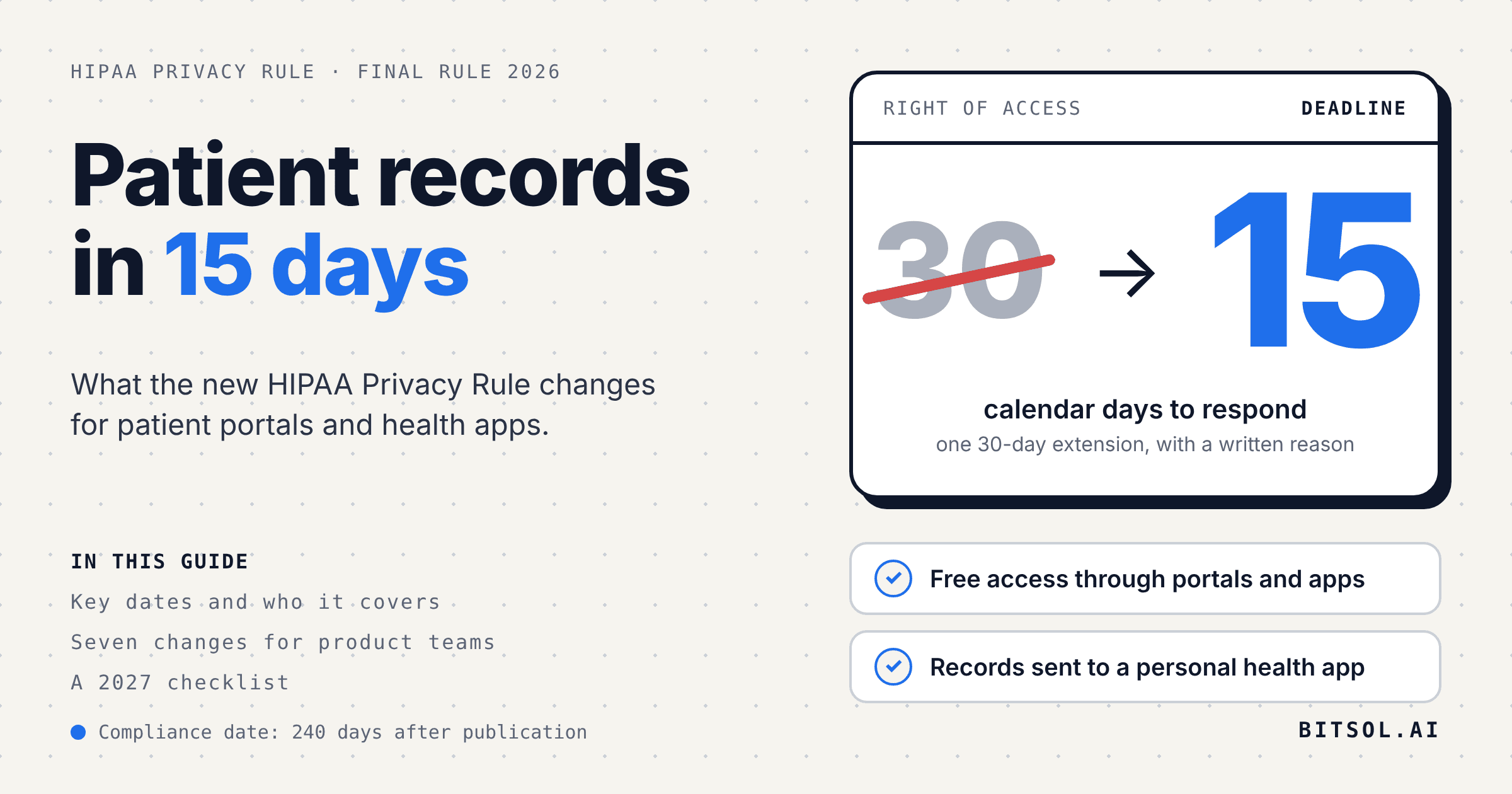
HHS has finalized a major update to the HIPAA Privacy Rule. On November 16, 2026, the HHS Office for Civil Rights issued a final rule that shortens the deadline for giving patients their records, changes how electronic access and fees work, and adds rules for personal health apps. The rule is titled "HIPAA Privacy Rule: Changes to Support Coordinated Care and Individual Engagement and Reduce Regulatory Burdens," and the Federal Register lists it as scheduled for publication on November 19, 2026.
This guide is written for HealthTech teams who build patient portals and health apps, because several of the changes land in the product, not only in the policy binder. Every requirement below is linked to the rule text or the HHS page, and our own recommendations are marked "we recommend."
What you will learn:
The key dates, and how they are calculated
Who the rule applies to
Seven changes that matter for product teams, and what each means for your product
A practical checklist for 2027
The rule at a glance
| Area | What changes | Rule section |
|---|---|---|
| Patient access deadline | 15 calendar days instead of 30, with one extension of up to 30 days | §164.524(b)(2) |
| Personal health apps | Copies sent to or through a patient's personal health app on request, when readily producible | §164.524(c)(3), §164.501 |
| Fees | No fee for inspection or access through an internet-based method; fee schedule posted online if fees are charged | §164.524(c)(4), §164.525 |
| Identity verification | No unreasonable verification measures | §164.514(h)(2)(v) |
| Notice of Privacy Practices | Written acknowledgment requirement removed; new right to discuss the notice | §164.520 |
| Care coordination | Disclosures to social services and community-based organizations expressly permitted | §164.506(c)(6), §164.501 |
| Business associate agreements | Extra transition time for qualifying existing agreements | §164.532(e) |
Step 1: Know the dates
The rule text sets its dates relative to publication. It takes effect 60 days after publication, and covered entities and their business associates must comply 240 days after publication. HHS describes the compliance date as 180 days after the effective date, which is the same thing.
If the rule is published on November 19, 2026 as scheduled, that gives:
Effective date: January 18, 2027
Compliance date: July 17, 2027
Latest date for qualifying business associate agreements: January 18, 2028 (see change 7)
The first two dates are calculated from the scheduled publication date. Confirm them against the published rule: January 18, 2027 is a federal holiday and July 17, 2027 is a Saturday, so the published dates may differ.
Step 2: Check whether the rule applies to you
The Privacy Rule applies to covered entities and to their business associates. The rule describes covered entities as health plans, health care clearinghouses and most health care providers. Business associates are the vendors that handle health information on a covered entity's behalf, such as a company that runs a patient portal for a hospital.
A consumer app that is not offered by or on behalf of a covered entity is not a regulated entity under HIPAA, and the rule notes that such personal health apps are not subject to the HIPAA Rules' privacy and security obligations. Our guide to whether HIPAA applies to your app explains how to tell. If you build software for a covered entity, the changes below will reach your product through your customers' compliance work.
Step 3: Understand seven changes that matter for product teams
The rule also covers disclosures to Telecommunications Relay Services, expands a permission covering Uniformed Services personnel, and confirms that health plans may do care coordination as health care operations, as the HHS page lists. The seven changes below are the ones that reach patient-facing software.
1. Patient records within 15 days
Today, a covered entity must act on a request for access no later than 30 days after receiving it. Under the final rule, it must act "as soon as practicable, but no later than 15 calendar days after receipt of the request." Only one extension of up to 30 calendar days is allowed, and the covered entity must send a written statement within the 15 days giving the reasons and the date it will complete the request. Where another federal or state law requires access in less than 15 days, that shorter period is deemed practicable.
The clock is strict. The 15 days include verifying the patient's identity, and talking with the patient about the scope of the request does not extend the time allowed. HHS states that, from the compliance date, a business associate that responds to access requests on a covered entity's behalf must also respond within 15 calendar days, even if its business associate agreement has not yet been updated. HHS also says the covered entity remains ultimately responsible for ensuring the requested information reaches the patient. A covered entity also may not use request measures that impede access: HHS says it generally would be unreasonable to require that requests for access be made only through a particular electronic method.
What it means for your product: we recommend timestamping every access request when it arrives, showing the deadline to staff, and alerting before day 15. A self-service download in the patient portal is the fastest way to meet "as soon as practicable," but we recommend keeping another way to request records for patients who do not use the portal.
2. Records through personal health apps
Under the final rule, when a patient asks, a covered entity must send the copy "to or through the individual's personal health application, if a copy is readily producible to or through such application." HHS says the rule does not independently require covered entities to implement new technology to gain this ability. The rule's new definition of a personal health application covers information "managed, shared, and controlled by or primarily for the individual."
As under the current rule, electronic copies must be given in the electronic form and format the patient requests, if readily producible. The final rule adds that a form and format required by other law is deemed readily producible, and HHS gives a secure, standards-based API as an example. Patients can also direct a covered entity to transmit an electronic copy of their health information in an electronic health record to a person they designate. That request must be "clear, conspicuous, and specific," and the same 15-day limit applies.
What it means for your product: we recommend checking which electronic formats your system can produce today, and how a patient's chosen app or designated person would receive them. We recommend treating data export as part of compliance work: under the rule, a format you already make available to others may count as readily producible for patients.
3. Free electronic access and posted fees
A covered entity may still charge a reasonable, cost-based fee for copies. The final rule adds that it "may not impose a fee" when a patient inspects their information, or accesses electronic information "using an internet-based method, such as a personal health application." For electronic copies delivered another way, such as on a USB drive by mail, the fee is limited to labor, with no charge for the media or postage.
A covered entity that charges fees for copies must post a fee schedule on its website, if it has one, and make it available at the point of service and on request. The schedule must list the types of access that are free and the standard fees for copies. One proposal did not make it into the final rule: the proposed right to take notes and photographs while inspecting records was not adopted.
What it means for your product: we recommend checking that portal and app downloads never trigger a charge, and publishing the fee schedule as a page on the website. A fee can still apply when a patient uses the portal only to order copies that need labor, supplies or postage.
4. No unreasonable identity checks
A covered entity "may not impose unreasonable verification measures" on someone exercising a Privacy Rule right. A measure is unreasonable when it causes unnecessary effort or resources and a less burdensome measure is practicable. HHS gives two examples: requiring a notarized request, or proof of identity in person when a more convenient remote method is practicable. What is practicable includes the security of electronic health information under the Security Rule.
What it means for your product: HHS notes that patient portals "already should be set up with appropriate authentication controls." We recommend not adding extra steps, such as notarized forms or in-person visits, when the patient's existing sign-in is enough. This does not mean weakening authentication; the rule still counts security as part of what is practicable.
5. Notice of Privacy Practices: acknowledgment dropped
The final rule removes the requirement for direct treatment providers to make a good faith effort to obtain a written acknowledgment that the patient received the Notice of Privacy Practices. The notice gains content: a new header, a right to "discuss the notice with a designated contact person or office," a contact that includes a "name or title, telephone number, and email address," and a description of free or limited-cost access and the right to direct copies to a third party. The rule also removes the exception for inmates.
What it means for your product: we recommend reviewing onboarding flows that ask patients to sign or tick an acknowledgment, and updating the notice text, header and contact details wherever your product shows the notice.
6. Care coordination with community services
A covered entity may disclose health information "to a social services agency, community-based organization, home and community based services provider" or a similar third party "that provides health or human services to specific individuals," for individual-level care coordination and case management for that patient. This is a permission, not a duty. HHS did not adopt its proposed exception to the minimum necessary standard for individual-level care coordination and case management, so that standard still applies.
What it means for your product: if your platform supports referrals or case management, we recommend recording who received each disclosure and why, and limiting what is shared to what the referral needs.
7. More time for business associate agreements
Qualifying existing business associate agreements are deemed compliant until the earlier of their renewal or modification on or after the compliance date, or January 18, 2028. The rule sets conditions: the agreement must have been in place and compliant before the publication date, and must not be renewed or modified between 60 and 240 days after publication. HHS says the extra time covers only the agreement paperwork, and that a business associate that answers access requests must still meet the 15-day deadline from the compliance date.
What it means for your product: if you are a vendor to covered entities, we recommend checking whether your agreement says who answers access requests, because customers will review it before January 18, 2028.
Step 4: Plan the work for 2027
We recommend this checklist for HealthTech teams before the compliance date:
Timestamp access requests and track the 15-day deadline, with alerts before it passes.
Keep a way to request records outside the portal, so the portal is never the only route.
Offer self-service download of records in the formats your system can readily produce.
Support delivery to a patient's personal health app where your system can readily produce it, and transmission to a person the patient designates.
Make sure portal and app access is always free, and publish the fee schedule on the website if fees are charged.
Remove verification steps that go beyond what the patient's sign-in already proves, without weakening authentication.
Review the Notice of Privacy Practices acknowledgment step, which HIPAA no longer requires, and update the notice text, header and contact details.
Log care coordination disclosures with the recipient and purpose, and share only what each referral needs.
Review business associate agreements with your customers and vendors, including who answers access requests.
Train support and records staff on the new deadlines.
How we approach the new Privacy Rule
Bitsol builds healthcare software only, with 50+ healthcare products shipped. We recommend treating this rule as product work, planned together with the compliance team, because patient access, export and fees are features patients use directly. For the engineering side of HIPAA, see our guides to the 12 engineering steps to a HIPAA-compliant application and HIPAA-compliant authentication with AWS Cognito.
Frequently asked questions
What is the new HIPAA deadline for patient access requests?
Under the final rule, a covered entity must act as soon as practicable, and no later than 15 calendar days after receiving the request. One extension of up to 30 calendar days is allowed, with a written statement of the reasons and the completion date sent within the 15 days. The current deadline is 30 days.
When does the new HIPAA Privacy Rule take effect?
The rule is effective 60 days after publication in the Federal Register, and compliance is required 240 days after publication. With publication scheduled for November 19, 2026, that gives January 18, 2027 and July 17, 2027. Both fall on non-business days, so confirm the dates against the published rule.
Can a covered entity charge for records accessed through a patient portal or app?
No. The final rule says a covered entity may not impose a fee when a patient inspects their information or accesses electronic information using an internet-based method, such as a personal health application. A fee can still apply when the portal is used only to order copies that need labor, supplies or postage.
Do providers still have to collect a signed acknowledgment of the Notice of Privacy Practices?
No. The final rule removes the requirement for direct treatment providers to make a good faith effort to obtain a written acknowledgment of receipt.
Does the rule apply to health apps?
It applies to covered entities and their business associates. A consumer app that is not offered by or on behalf of a covered entity is not regulated under HIPAA, but apps built for providers or health plans will feel the changes through their customers.