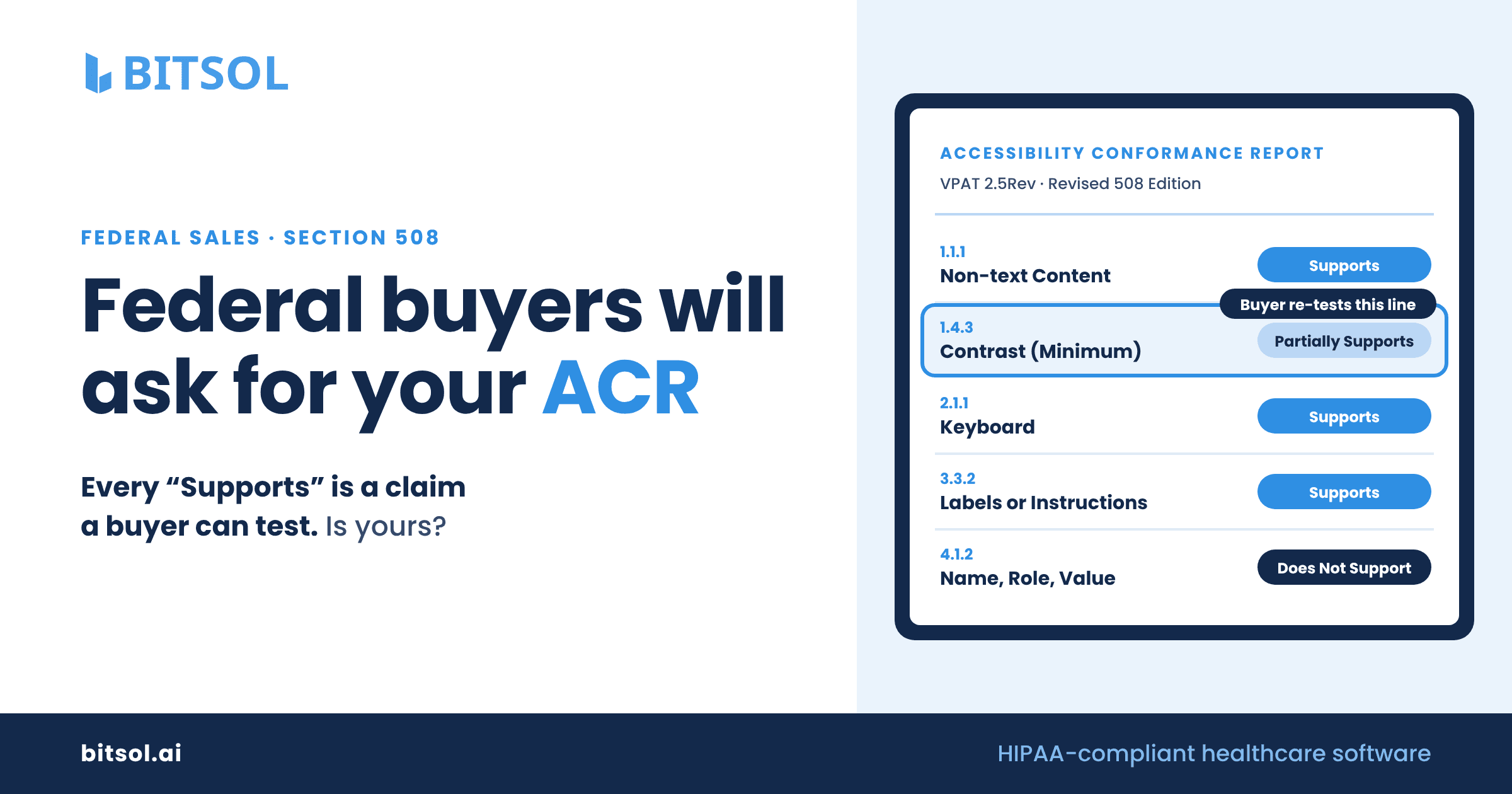
A HealthTech company wins a pilot with a federal agency, and the contracting officer asks for one document before the contract can move: an Accessibility Conformance Report. The HealthTech team has never tested with a screen reader, and the report it sends back says "Supports" on every line. That report is a statement the buyer relies on, and the General Services Administration (GSA) now tells agencies to check such statements. In GSA's FY 2025 Governmentwide Section 508 Assessment, agencies reported an average Section 508 conformance of 1.96 on a 5-point scale. Fewer than half of their most viewed or used information and communication technology (ICT) assets were fully conformant, and about half of agencies said they do not routinely test for accessibility. GSA's recommendation is to use acquisition as a primary lever, "validating accessibility claims, enforcing contract requirements, and holding vendors accountable."
This guide is for HealthTech teams that sell, or plan to sell, software to federal agencies. Requirements are linked to the law, the regulation, the standard or agency guidance, and our own recommendations are marked "we recommend."
What you will learn
Why Section 508 binds federal agencies, and how it still reaches a HealthTech vendor through procurement.
What the Revised 508 Standards require of web portals, mobile apps and support documentation.
How Section 508, Section 504 and the ADA differ, and why one WCAG 2.2 build can serve all three.
What an Accessibility Conformance Report (ACR) is, and how it relates to the VPAT.
How to fill in the four conformance levels.
Five practices that make an ACR credible to a federal buyer.
What Section 508 requires
Section 508 of the Rehabilitation Act (29 U.S.C. 794d) applies to federal agencies, not directly to companies. The Federal Acquisition Regulation (FAR) puts it into practice. When acquiring ICT, agencies must ensure comparable access to and use of information and data for two groups: federal employees with disabilities, and members of the public with disabilities who seek information or services from an agency (39.201(c)).
The same FAR subpart says that, unless an exception (39.204) or an exemption (39.205) applies, "acquisitions for ICT supplies and services shall meet the applicable ICT accessibility standards at 36 CFR 1194.1" (39.203(a)). When an agency buys commercial products, it must comply with the standards "that can be met with supplies or services that are available in the commercial marketplace and that best address the agency's needs" (39.203(d)). Where no commercial product fully conforms, the agency must buy the one "that best meets the ICT accessibility standards consistent with the agency's needs" (39.205(a)(3)). In practice, that makes accessibility a factor in choosing between vendors.
The FAR is being rewritten through the Revolutionary FAR Overhaul (RFO), and the requirement itself is not changing. What changes is the section number. The codified FAR still carries the rule at 39.203, while the RFO Part 39 text carries it at 39.104-3, and GSA's class deviation RFO-2025-39 has GSA staff following that RFO text now. The FAR Council proposed further RFO changes that include Part 39 on June 23, 2026, and we found no final rule as of November 24, 2026. Expect a buyer to cite either number.
What the Revised 508 Standards contain
The standards that the FAR points to are the U.S. Access Board's Revised 508 Standards, which took effect on January 18, 2018. For a HealthTech product, four parts matter most:
Electronic content must conform to the Level A and Level AA success criteria and conformance requirements of the Web Content Accessibility Guidelines (WCAG) 2.0 (E205.4). WCAG grades its criteria A, AA and AAA, and E205.4 is the provision number in the standards. This covers public-facing content (E205.2), and non-public-facing content used for official business, such as forms, notices and training materials (E205.3).
Software, including the content of applications, must also conform to WCAG 2.0 Level A and AA (E207.2). For non-web software (E207.2) and non-web documents (E205.4), four success criteria do not apply: 2.4.1 Bypass Blocks, 2.4.5 Multiple Ways, 3.2.3 Consistent Navigation and 3.2.4 Consistent Identification. Non-web software is also excused from the Complete Processes conformance requirement.
Software requirements beyond WCAG in Chapter 5, such as 503.2: applications "shall permit user preferences from platform settings for color, contrast, font type, font size, and focus cursor." Applications designed to be isolated from their platform, including web applications, are excepted from 503.2, so it lands mainly on native apps, where it means honoring the system text size and contrast settings.
Support documentation, including web-based self-service support, must conform to WCAG 2.0 Level A and AA (602.3).
The standards also include a legacy exception: existing ICT that already met the earlier 508 standards and has not been altered on or after January 18, 2018 does not need to be modified. The exception covers only that existing ICT. It does not cover new purchases, and a component that is altered, meaning a change that affects interoperability, the user interface, or access to information or data, must meet the current standards.
Web and mobile under Section 508
Section508.gov's applicability guidance groups native mobile apps with non-web software, so they are held to WCAG 2.0 Level A and AA through E207.2, and to the Chapter 5 software requirements. A web portal is electronic content and web software. W3C's WCAG2ICT is an informative note that explains how to apply WCAG to non-web software such as native apps. Its current edition maps WCAG 2.2, so it is guidance, not the 508 requirement. We recommend testing and reporting web and mobile separately, because the same criterion is met in different ways: semantic HTML and ARIA on the web, and accessibility labels, VoiceOver, TalkBack and system font scaling on iOS and Android.
Section 508, Section 504 and the ADA
The three laws cover different organizations and do not all point to the same version of WCAG.
| Law | Who it covers | Technical standard | How it reaches a HealthTech vendor |
|---|---|---|---|
| Section 508 | Federal agencies, for the ICT they develop, procure, maintain or use | WCAG 2.0 Level A and AA, through the Revised 508 Standards | Federal procurement and the ACR |
| Section 504 (HHS rule) | Organizations that receive HHS federal financial assistance | WCAG 2.1 Level A and AA, from May 11, 2027 for recipients with 15 or more employees and May 10, 2028 for smaller ones | Covers web content and mobile apps a provider offers "directly or through contractual, licensing, or other arrangements" |
| ADA Title II (DOJ rule) | State and local government entities | WCAG 2.1 Level A and AA | Indirectly, through work for those entities |
We recommend building to WCAG 2.2 Level AA. W3C says WCAG 2.2 "builds on and is backwards compatible with WCAG 2.1," so one build can serve a federal buyer, a provider and a public health system. Within WCAG, the one gap is criterion 4.1.1 Parsing, which WCAG 2.2 removed. W3C notes that teams held to an earlier version "may need to continue to test and report 4.1.1," and a 508 report is one of those cases. A 508 report also covers requirements outside WCAG, such as the Chapter 5 software rules above. For the Section 504 dates and what to fix first, see our guide to HealthTech accessibility and Section 504.
The ACR and the VPAT
An Accessibility Conformance Report (ACR) "explains how information and communication technology (ICT) products such as software, hardware, electronic content, and support documentation meet (conform to) the Revised 508 Standards for IT accessibility." Section508.gov says ACRs help federal contracting officials and government buyers assess accessibility during market research and when evaluating proposals, and it recommends that vendors generate one for any ICT marketed to the federal government.
Most ACRs are written with the Voluntary Product Accessibility Template (VPAT) from the Information Technology Industry Council (ITI). ITI explains that the VPAT is the template, and once it is completed for a specific product, the finished document is the ACR. The latest version, VPAT 2.5Rev, was released in April 2025 in four editions: 508, EN 301 549, WCAG and INT, and ITI describes INT as the international edition that includes all three standards. Section508.gov says that if you are selling to the U.S. federal government, you must use the Revised Section 508 edition or the INT edition. Its how-to page still names version 2.4 and says any VPAT 2.x is acceptable.
How to fill it in
Section508.gov says the product owner "must first test the product" against the standards before completing an ACR. Each criterion then gets one of four conformance levels:
| Conformance level | What it means |
|---|---|
| Supports | The product has at least one method that meets the criterion without known defects, or meets it with equivalent facilitation |
| Partially Supports | Some functionality does not meet the criterion |
| Does Not Support | The majority of product functionality does not meet the criterion |
| Not Applicable | The criterion is not relevant to the product |
"Equivalent facilitation" is the standards' term (E101.2) for an alternative design or technology that gives substantially equivalent or greater accessibility and usability. Remarks are required for any criterion marked Partially Supports or Does Not Support. "Not Evaluated" may only be used for the Level AAA table, and only Level A and AA are required in an ACR for U.S. federal procurement. Section508.gov also offers an ACR Editor that produces machine-readable reports in the OpenACR format, and describes an ACR Issue Detail Supplement, a best-practice companion that adds severity, scope, affected users and workarounds for each issue. A buyer can require it in a solicitation.
What makes an ACR credible
We recommend five practices:
Test before you write. Combine automated checks with manual testing of each core journey, from sign-in to messaging, using a keyboard, a screen reader and the largest system text size. Buyers may test too: Section508.gov tells purchasers to conduct independent conformance validation testing.
Write one ACR per product and platform, with a version number and report date, so the web portal and the mobile app are not hidden in one document.
Mark Partially Supports wherever it applies, and say in the remarks what fails, where, and when it will be fixed.
Describe the evaluation methods, a required field in the VPAT, in enough detail, including the assistive technologies you used, that a buyer can repeat the test.
Update the ACR with each major release. Publish it where buyers can find it, which Section508.gov also recommends.
How Bitsol approaches the ACR in a HealthTech product
Bitsol builds healthcare software only, with 50+ healthcare products shipped. We recommend treating the ACR as an output of the build, not a document written at the end of a sales cycle. Test against WCAG as features ship, keep the results per platform, and the ACR follows from the evidence. For a security review that also runs on test evidence, see our guide to the CASA assessment for the Google Health API. For questions to ask any development partner, see how to choose a HIPAA-compliant software development company. If you are building a HealthTech product with federal or enterprise buyers in mind, read our guide to HealthTech app development, and get in touch if you want to plan accessibility from the first sprint.
Conclusion
Section 508 binds agencies, not vendors, but it shapes which products agencies can buy. The core standard is WCAG 2.0 Level A and AA today, the document buyers read is the ACR, and the government's own assessment shows about half of agencies do not yet test routinely. A HealthTech team that tests on web and mobile, reports what it finds and builds to WCAG 2.2 can answer a federal buyer, a hospital under Section 504 and a public health system under the ADA from one body of evidence. Two dates are worth tracking: a final rule on FAR Part 39 from the Revolutionary FAR Overhaul, and May 11, 2027, when HHS-funded providers with 15 or more employees must meet WCAG 2.1 Level AA.
Frequently asked questions
Does Section 508 apply to private HealthTech companies?
Not directly. Section 508 applies to federal agencies. It reaches companies through federal procurement, because agencies must buy ICT that meets the Revised 508 Standards unless an exception or exemption applies.
Which version of WCAG does Section 508 use?
WCAG 2.0 Level A and Level AA, through the Revised 508 Standards, which took effect on January 18, 2018. For non-web software and documents, four WCAG 2.0 success criteria do not apply.
What is the difference between a VPAT and an ACR?
The VPAT is the template from the Information Technology Industry Council. Once it is completed for a specific product, the finished document is the Accessibility Conformance Report, or ACR.
Which VPAT edition should I use for federal sales?
Section508.gov says vendors selling to the U.S. federal government must use the Revised Section 508 edition or the INT (international) edition, which ITI says includes all three standards. The latest version is VPAT 2.5Rev, released in April 2025.
Does Section 508 apply to mobile apps?
Yes. Section508.gov groups native mobile apps with non-web software, so they must conform to WCAG 2.0 Level A and AA and to the software requirements in Chapter 5, such as respecting platform settings for color, contrast and font size in native apps.